Core stability is not about bracing harder. It is about creating enough support that the rest of your body can stay soft, responsive and available.
If you have ever been told to:
“Engage your core.”
“Sit taller.”
“Use your abs.”
…you may have understood the words without really knowing what they should feel like in your body.
For dressage riders, core stability is often misunderstood.
It is not about tightening your stomach as hard as possible.
It is not about holding your spine rigidly in place.
And it is not about creating a perfectly still torso.
A good rider needs something much more subtle.
You need enough support through the centre of your body to stay organised while your pelvis, hips, ribcage and limbs respond to the horse beneath you.
That is what true core stability is.
At the centre of that system is one muscle many riders have heard of but do not always understand well: the transverse abdominis, or TVA.
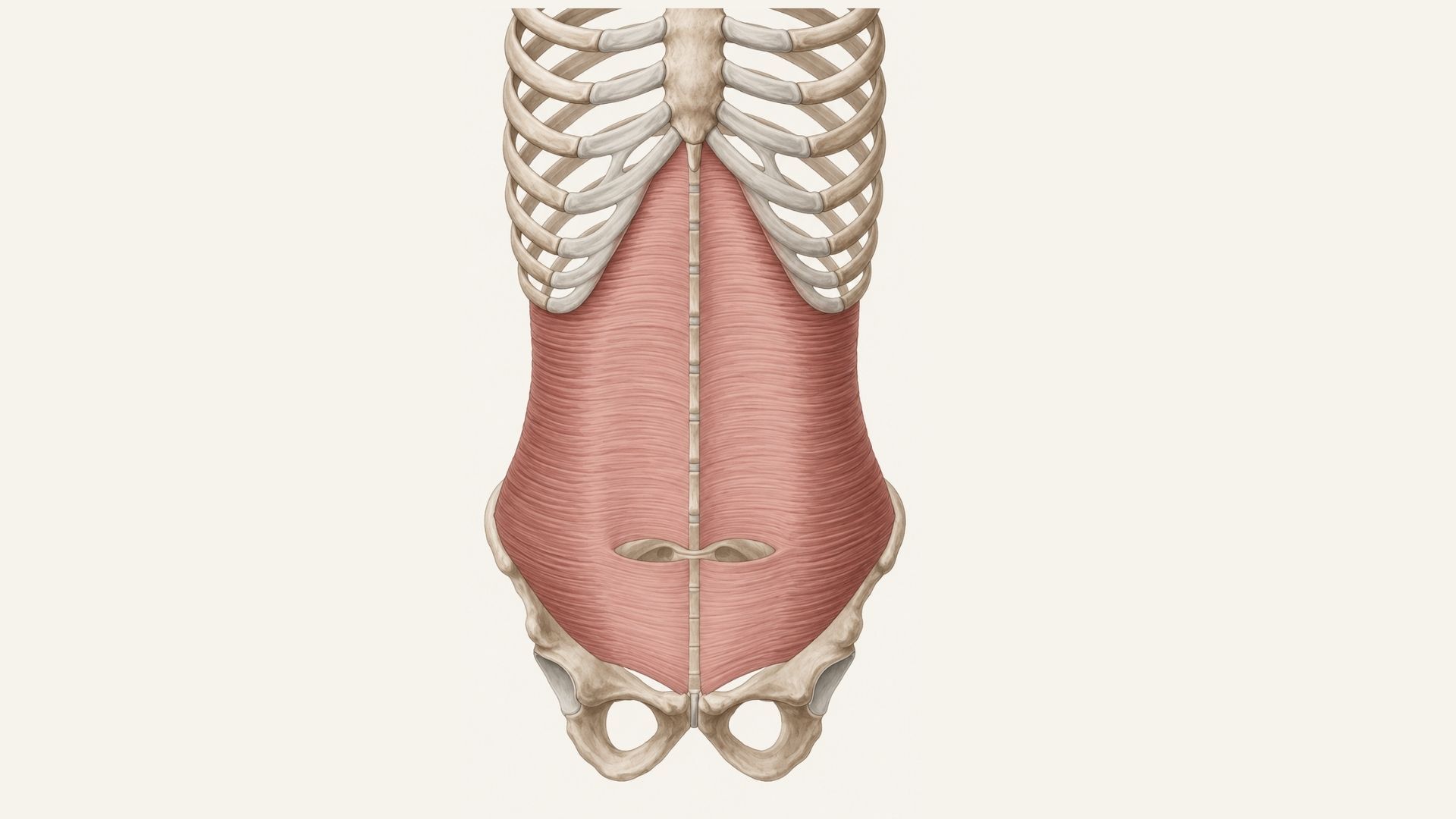
What Is the Transverse Abdominis?
The transverse abdominis is the deepest layer of the abdominal wall.
Unlike the rectus abdominis—the “six-pack” muscle—it does not primarily create large trunk movements.
Instead, the TVA wraps around the torso and contributes to pressure control and stability through the abdomen, spine and pelvis.
It works as part of a larger system alongside:
- the diaphragm
- pelvic floor
- obliques
- deep spinal stabilisers
- muscles around the hips and pelvis
That is important.
The TVA does not stabilise you on its own.
It is one part of a coordinated system.
For riders, that system helps create the quiet internal support that allows movement to happen around it.
Your hips can follow.
Your pelvis can respond.
Your shoulders can stay softer.
Your legs can work independently.
And your hands are less likely to become the place where you try to find balance.
Core Stability Does Not Mean a Fixed Core
The word “stability” can make riders think they need to stop movement.
But riding is movement.
Your horse’s back is moving beneath you in every gait.
Your pelvis is responding.
Your ribcage is making small adjustments.
Your legs are absorbing and giving information.
So the goal is not to stop all of that.
It is to remain organised inside it.
A stable rider is not a rigid rider.
They are a rider who can move without losing themselves.
That is a much more useful way to think about the core.
Why Core Stability Matters in Dressage
When you ride, your body is constantly responding to:
- changes in rhythm
- changes in gait
- transitions
- lateral work
- collection
- different horses
- left-to-right asymmetries
- changes in balance beneath you
Your core helps you manage those forces.
When the support through the centre is effective, you are better able to:
- stay balanced without gripping
- sit deeper without pushing down
- use your legs independently
- maintain clearer posture
- absorb movement rather than resist it
- keep your hands quieter
- recover more quickly when you are displaced
This is why core strength can make a rider feel softer.
Strong riders often feel softer because their bodies do not need to hold on as much.
The TVA and the Pelvis
The pelvis sits at the centre of your riding position.
Above it sits the spine and ribcage.
Below it sit the hips and legs.
The TVA contributes to the support around this central area.
If the trunk is not well organised, you may notice:
- excessive arching through the lower back
- flattening or tucking of the pelvis
- difficulty sitting evenly
- instability in sitting trot
- one side collapsing
- the thighs gripping
- fatigue through the back or hips
This does not mean the TVA is “weak” every time one of these things happens.
The body is much more complex than that.
But it can mean that your deep stabilising system needs better coordination, endurance or strength.
Stability Gives Your Hips More Freedom
One of the most useful ways to understand core stability is this:
The more appropriately supported your centre is, the less your hips need to create stability for you.
When the trunk does not feel secure, the body often looks for support elsewhere.
The thighs grip.
The knees pinch.
The lower back braces.
The feet push into the stirrups.
The hands become busier.
But when the trunk can quietly support the pelvis, the hips have more opportunity to move.
The thighs can drape.
The pelvis can follow the horse.
The seat becomes deeper without needing to be forced.
This is why core stability and hip suppleness belong together.
One creates support.
The other creates freedom.
Bracing Versus Hollowing
Many riders have been taught to “pull the belly button in.”
That cue can sometimes create too much hollowing or tension.
The abdomen pulls inward.
The breath becomes smaller.
The ribcage stiffens.
The rider may feel “engaged,” but also less able to respond.
A better aim is gentle abdominal bracing.
That means creating support around the whole trunk rather than drawing one point inward.
Think:
- firm, not hard
- supported, not sucked in
- able to breathe
- able to move
The sensation should feel like quiet internal support.
Not maximum effort.
Not a bodybuilding brace.
Not a breath hold.
Just enough tension to help the body remain organised.
Your Core Should Be Able to Adapt
Good core function is not about staying switched on at one level all the time.
The amount of support you need changes.
Walking on a long rein may require very little.
A big transition, powerful canter or lateral movement may ask for more.
Then the body should be able to soften again.
That adaptability is important.
A core that cannot relax is not truly responsive.
A core that cannot increase support when needed is not truly stable.
We want a system that can do both.
Core Stability and Sitting Trot
Sitting trot is a good example of why this matters.
The horse’s back is moving quickly beneath you.
Your pelvis needs to respond.
Your hips need to remain available.
But your upper body also needs enough support that you are not being displaced by every stride.
If you lack support, the body may respond by gripping through the thighs or bracing the back.
If you over-brace the core, the pelvis becomes rigid and cannot follow.
The goal sits in the middle.
Enough support to stay organised.
Enough freedom to move.
That balance is what creates the appearance of stillness.
Core Stability Exercises for Dressage Riders
The goal of these exercises is not to exhaust your abs.
It is to teach your body how to create support while your arms and legs move.
That is far more relevant to riding.
Each exercise below develops one part of that skill.
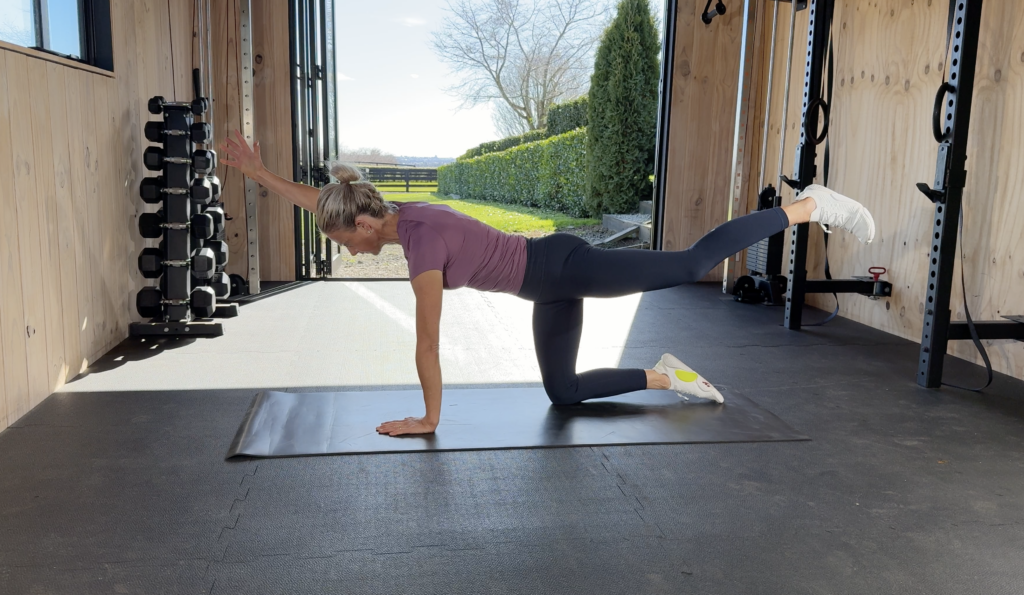
1. Leg Lowers
Lie on your back with your hips and knees bent to around 90 degrees.
Bring your ribs and pelvis into a comfortable stacked position.
Create a gentle brace through the abdominal wall.
Slowly lower one leg—or both legs, depending on your level—toward the floor.
Stop before your lower back arches or your pelvis shifts.
Return with control.
Why it helps riders
Leg lowers teach you to resist unwanted extension through the lower back.
That can be useful when riding:
- powerful canter
- transitions
- larger-moving horses
- moments where the body wants to arch and brace
The range does not matter.
Control does.
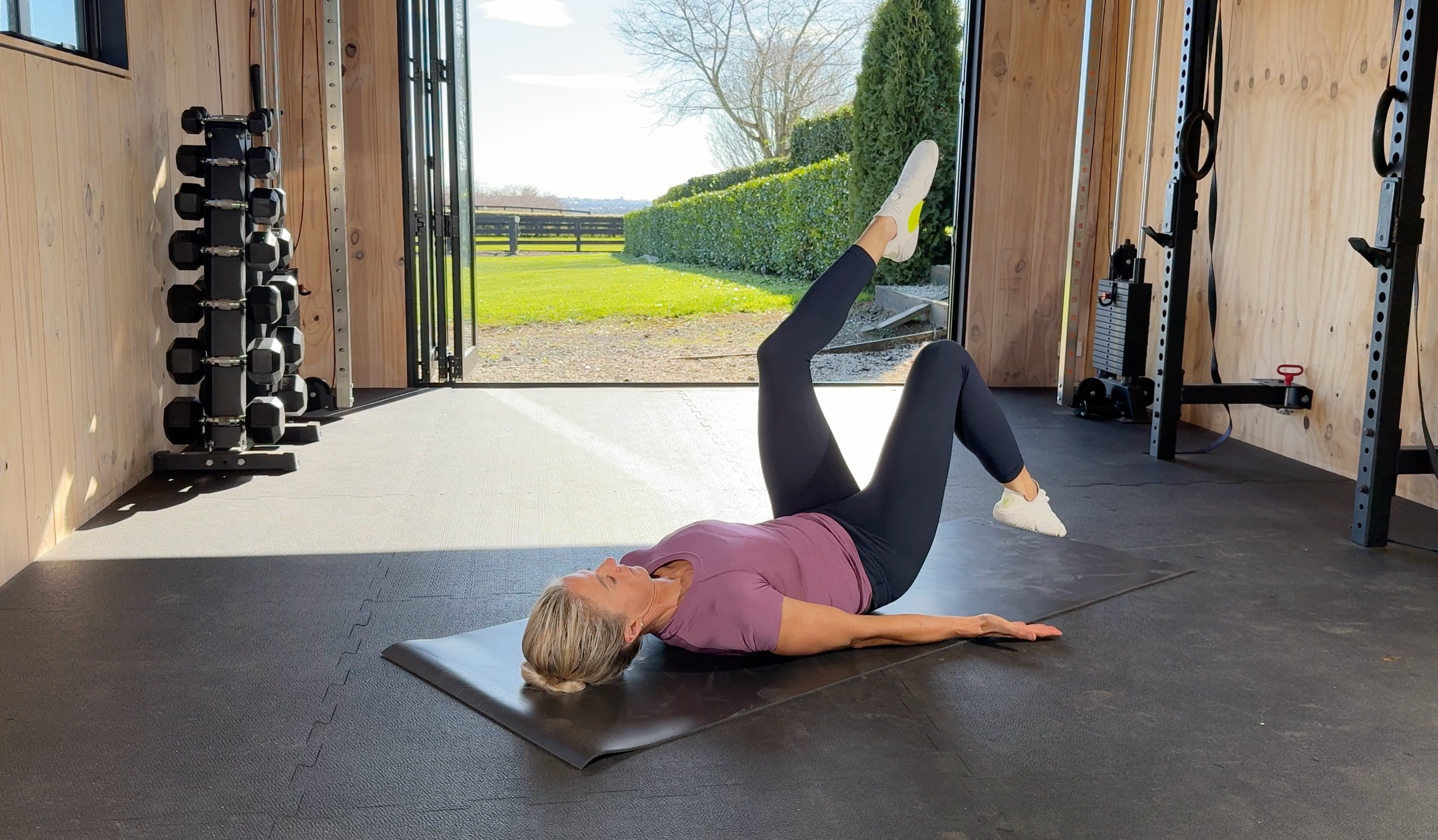
2. Banded Dead Bug
Lie on your back with your hips and knees bent to 90 degrees.
Hold a resistance band anchored overhead.
Create gentle trunk support.
Extend one leg away while maintaining tension through the band.
You can add the opposite arm movement depending on how the exercise is set up.
Return slowly and alternate sides.
Why it helps riders
The banded dead bug trains cross-body coordination.
This matters because riding constantly asks the two sides of your body to work differently.
One leg may be giving an aid while the opposite side of the trunk stabilises.
The exercise helps you remain organised while opposite limbs move.
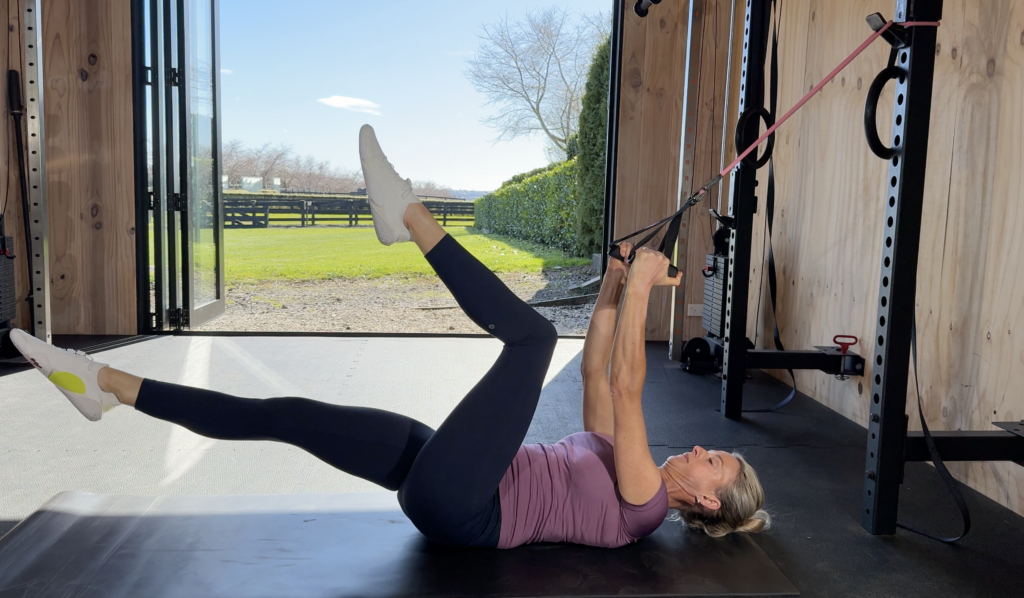
3. Bird Dog
Begin on hands and knees.
Stack the hands under the shoulders and knees under the hips.
Create gentle abdominal support.
Extend one arm forward and the opposite leg backward.
Keep the pelvis level and avoid arching through the lower back.
Return slowly and alternate sides.
Why it helps riders
Bird dogs help develop:
- pelvic control
- cross-body coordination
- spinal stability
- glute and trunk integration
They are particularly useful for riders who feel more stable on one side than the other.
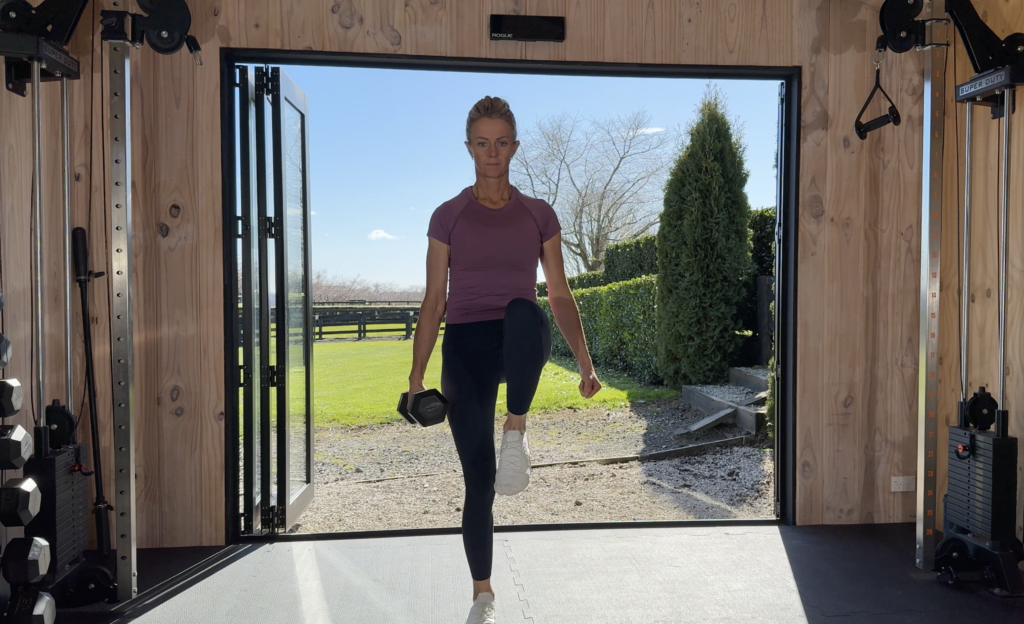
4. Suitcase March
Stand tall while holding a dumbbell or kettlebell in one hand.
Keep the ribs stacked over the pelvis.
Create enough trunk support to resist leaning toward the weight.
Slowly lift one knee, then the other, as though marching.
Keep the body quiet.
Switch the weight to the opposite hand for the next set.
Why it helps riders
This exercise develops lateral trunk stability.
It teaches you to stay organised when one side is carrying more load.
That can translate well to riders who:
- collapse through one side
- feel one rein more strongly
- weight one seat bone more
- struggle to remain centred
5. Rotating Side Plank
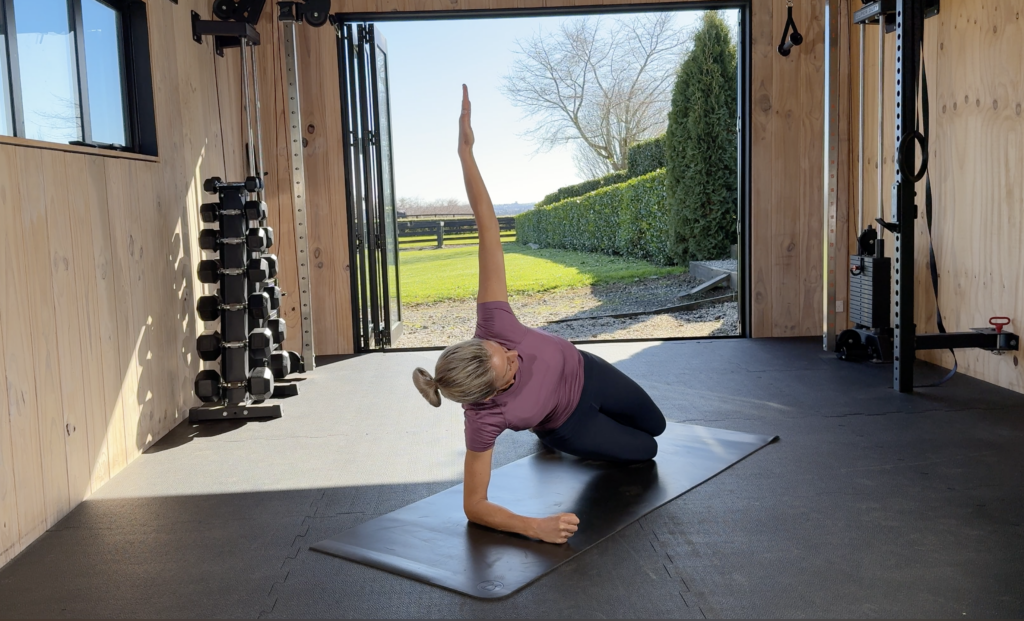
Begin in a side plank on your forearm.
Use bent knees if needed, or straight legs for a harder version.
Keep the hips lifted.
Rotate the top arm under the body, then open back toward the ceiling.
Move slowly.
Why it helps riders
This trains the obliques to control rotation.
That matters during:
- bending
- circles
- lateral work
- changes of direction
The goal is not to create as much rotation as possible.
It is to control rotation without collapsing.
6. Pallof Press
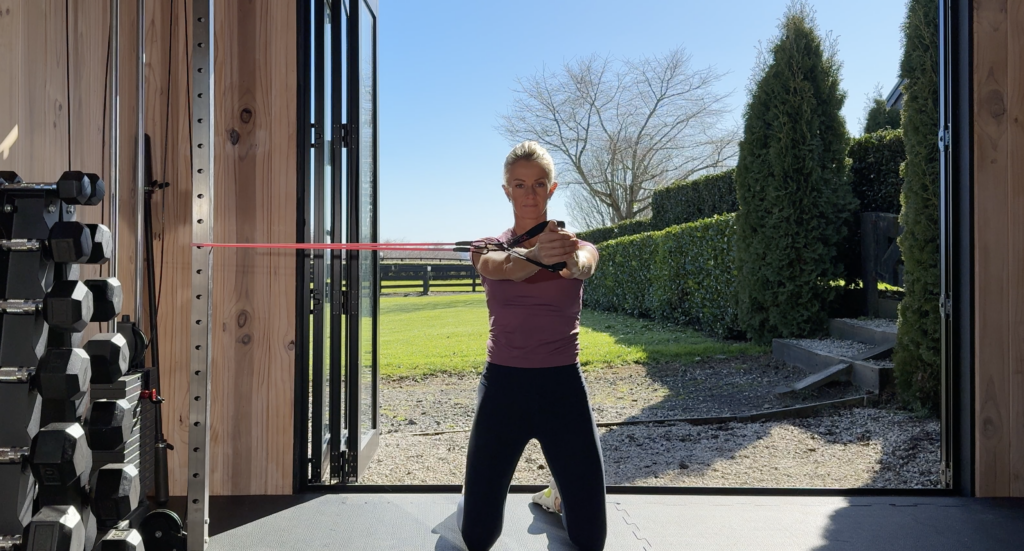
Stand or kneel sideways to a resistance band or cable anchored at chest height.
Hold the band close to the chest.
Create gentle trunk support.
Press the band straight out in front of you.
Resist the pull trying to rotate your body.
Return with control.
Why it helps riders
The Pallof press trains anti-rotation strength.
This helps the rider stay organised when one side of the body is under more demand.
It is particularly useful for improving awareness of:
- crookedness
- one-sided collapse
- uneven rein contact
- trunk control during lateral work
The Goal Is Not Stronger Abs
The goal is a more capable system.
You want your core to support you so that:
- the pelvis can move
- the hips can stay available
- the spine can respond
- the legs can work independently
- the hands can stay quieter
That is very different from simply having strong abdominal muscles.
You can be very strong in the gym and still brace in the saddle.
Rider-specific core training is about coordination.
It is about when to create support.
How much support to use.
And when to let go again.
Do Not Train the Core in Isolation Forever
Core training matters.
But the body does not work in pieces.
The trunk, hips and pelvis all interact.
So over time, core stability work should sit alongside:
- hip suppleness
- glute strength
- single-leg training
- rotational control
- whole-body strength
That is where the greatest transfer to riding happens.
The more integrated the training becomes, the more useful it becomes in the saddle.
What Better Core Stability Feels Like
You may notice:
Your seat feels more secure.
Your legs grip less.
Your hands become quieter.
Your pelvis moves without feeling loose.
You recover more quickly after a spook or imbalance.
Your position feels easier to maintain.
You can use one leg without shifting the whole body.
Sitting trot becomes less effortful.
The important thing is that the change often feels like less work, not more.
You are not creating more tension.
You are creating better support.
First Create Support. Then Allow Softness.
A lot of riders spend years trying to relax.
But relaxation without enough support can feel unsafe to the body.
That is when the thighs, back or hands step in.
Core stability gives the body another option.
It creates enough internal support that the outer layers can soften.
This is why I often say:
A soft seat is not passive.
It is supported.
The rider is doing plenty.
It just does not look or feel like unnecessary effort.
Where to Begin
If your core feels difficult to engage or you are not sure what “support” should feel like, start with simple exercises where the body is well supported.
Leg lowers.
Dead bugs.
Bird dogs.
Then progress toward exercises that add load and challenge asymmetry.
Suitcase marches.
Side planks.
Pallof presses.
The goal is not to rush.
Build control first.
Then endurance.
Then strength.
This is exactly how we approach rider-specific core training inside DRT.
Build the Kind of Core Stability Riding Actually Needs
Our Core Stability Program is designed to help riders develop the kind of support that translates into the saddle.
Not generic ab workouts.
Not endless crunches.
But progressive exercises that teach the trunk, pelvis and hips to work together.
Because when your centre becomes more organised, the rest of your body has more freedom.
Your seat can soften.
Your legs can become quieter.
Your posture becomes easier to maintain.
And your aids become clearer.
That is the kind of core stability I want riders to build.
Support that does not make you rigid.
Strength that gives you more freedom.
👉 Explore the DRT Core Stability Program and start building the kind of support that allows your seat to soften, your posture to organise itself, and your riding to feel more effortless.