These small muscles sit deep around the hip joint, helping control the thigh, support the pelvis and influence how evenly you sit in the saddle
When riders think about the muscles around the hips, the glutes usually get most of the attention.
They are large.
Easy to feel.
And regularly blamed when the pelvis feels unstable or the leg position is difficult to organise.
But beneath the glutes sits a smaller group of muscles that also plays an important role in how the hip moves and stabilises.
They are often referred to as the deep six.
Individually, these muscles are relatively small.
Together, they help control the thigh bone within the hip socket and contribute to stability through the hip and pelvis.
For riders, this matters because the position and control of the thigh influence:
- how evenly you sit on both seat bones
- how your legs drape around the horse
- how easily your hips follow the movement
- whether one leg rotates outward more than the other
- how clearly you can use each leg independently
- how stable your pelvis feels in the saddle
The deep six are not the answer to every hip or position problem.
No muscle group works alone.
But understanding them can help you see why a difference at the hip may show up much farther down the leg—or even change what you feel through your seat.
What Are the Deep Six Muscles?
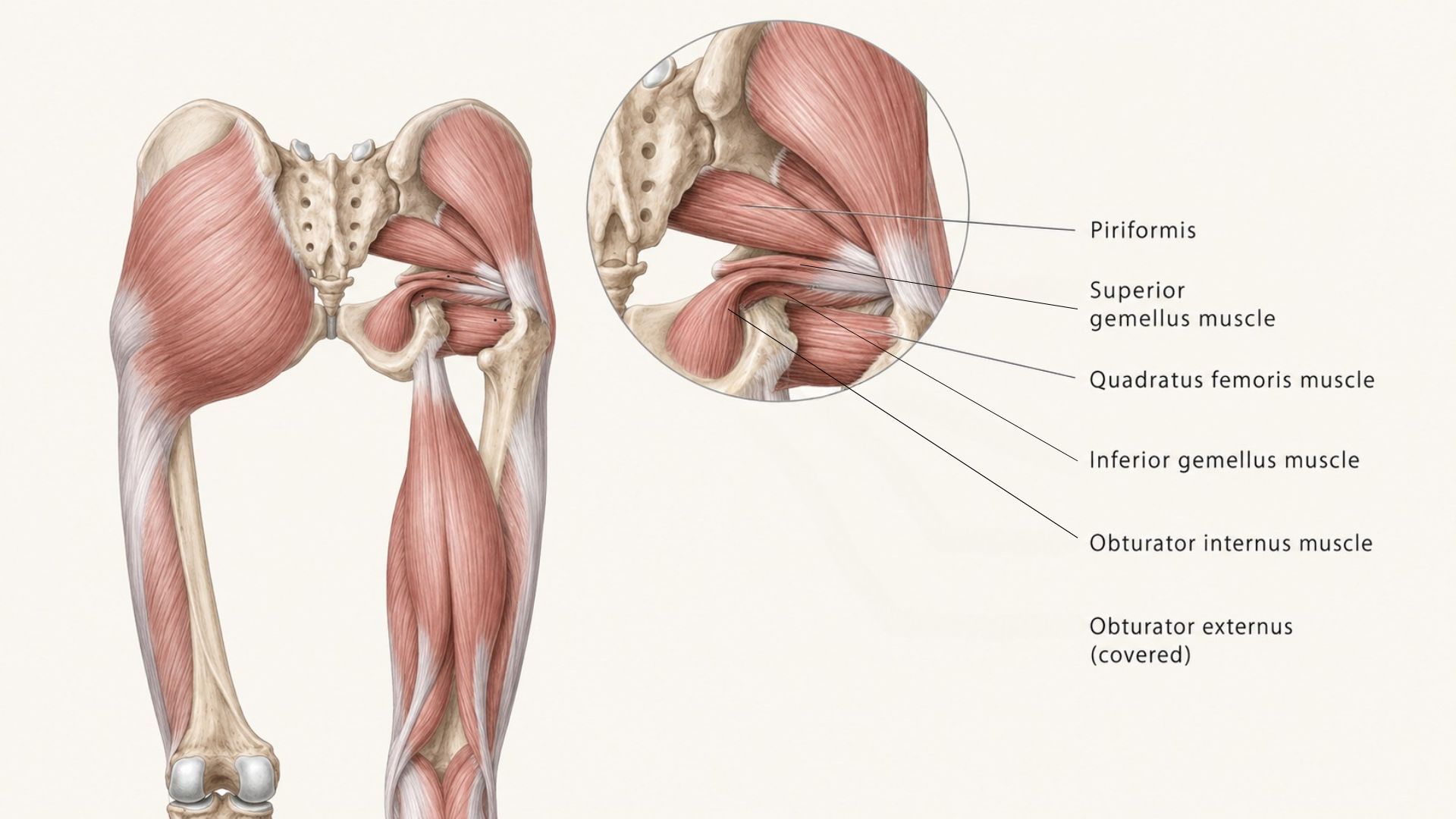
The deep six are a group of small muscles located behind the hip joint, underneath the larger gluteal muscles.
They are:
- Piriformis
- Superior gemellus
- Inferior gemellus
- Obturator internus
- Obturator externus
- Quadratus femoris
They are often discussed together because they share similar roles and work closely as a group.
One of their best-known actions is externally—or laterally—rotating the thigh.
This means turning the femur outward within the hip socket, which can cause the knee and toes to turn away from the body’s midline.
But their role is not limited to rotation.
They also contribute to controlling and stabilising the head of the femur within the hip socket as the leg moves.
That combination of movement and stability is exactly why they are relevant to riders.
Why the Deep Six Matter in the Saddle
Your thigh bones need to move continuously within the hip sockets while you ride.
They respond to the width of the horse.
The shape of the saddle.
The movement of the gait.
And the shifting relationship between your pelvis and the horse’s back.
At the same time, the hip joint needs enough control to stop the thigh moving without direction.
The deep six help contribute to that control.
They work alongside the glutes, adductors, hip flexors, hamstrings, abdominals and other muscles around the pelvis.
When the whole system is working well, the thigh can remain supported while still responding to the horse.
When one side is tighter, weaker or less coordinated, you may notice changes such as:
- one knee sitting farther away from the saddle
- one toe turning outward more
- one thigh feeling shorter
- one seat bone feeling heavier
- one hip feeling more restricted
- difficulty sitting evenly
- one leg gripping more than the other
These are not proof that the deep six are the problem.
But they may be part of the pattern.
Your Toe Position Begins Higher Than the Foot
Riders are often told to point their toes forward.
But toe position is influenced by what is happening much higher in the leg.
When the thigh rotates outward in the hip socket, the knee and foot tend to follow.
Trying to twist the toe inward without changing the position of the thigh may simply create more tension through the knee or ankle.
This is why working directly on the foot rarely creates lasting change.
The better question is:
What is happening at the hip?
Can the thigh move into a more neutral position?
Does one hip rotate more freely?
Is the thigh being pulled outward because the surrounding muscles are tight, weak or trying to stabilise the pelvis?
Position is usually the outcome of how the whole system is working.
One Side Will Often Feel Different
You have a deep-six group on each side.
And those two sides will not necessarily feel the same.
Most of us have a dominant leg.
We stand more heavily on one side.
Mount from the same side.
Carry feed buckets the same way.
Cross the same leg while sitting.
Turn toward the same side when working.
Previous injuries and years of repeated movement can also influence how each hip behaves.
As a result, one side may be:
- stronger
- tighter
- more stable
- more externally rotated
- less coordinated
- more willing to bear weight
This can affect how you sit in the saddle.
If one hip is more restricted, that side of the pelvis may feel lifted or less able to follow the horse.
The body may then place more weight through the opposite seat bone.
You may feel as though the horse is crooked when some of what you are experiencing is coming from your own asymmetry.
That does not mean the horse is never crooked.
It means the rider’s body is always part of the information being felt.
Your Seat Bones Depend on More Than the Pelvis
Riders often focus on placing equal weight through both seat bones.
But equal weight cannot always be forced by simply thinking about sitting evenly.
The position of the thighs influences the pelvis.
The hips influence how each side of the pelvis can move.
And the muscles around the joint influence how secure or available that side feels.
If one thigh rotates outward more than the other, it may alter how the pelvis rests on the saddle.
If one hip feels tight, the body may shift away from it.
If one side does not feel stable, the opposite leg or seat bone may begin doing more.
This is why seat symmetry is not purely a matter of concentration.
Your body needs enough suppleness and control to support the position.
The Deep Six and Single-Leg Control
The deep hip rotators also contribute to movement when the body is supported on one leg.
Walking is a simple example.
For a brief moment during every step, the body is balanced over one side while the opposite leg moves.
The muscles around the standing hip help control the pelvis and thigh.
Riding also contains many left-to-right demands.
Although you are sitting on both seat bones, the horse’s back is moving differently beneath each side.
Your legs give separate aids.
Your pelvis responds to alternating forces.
One side often needs to stabilise while the other becomes more active.
This is one reason single-leg exercises are so valuable for riders.
They expose differences that can remain hidden during two-legged movements.
You may discover that one side:
- struggles to balance
- rotates outward
- collapses inward
- fatigues more quickly
- feels less controlled
- grips instead of stabilising
Again, the deep six are only part of that picture.
But they contribute to the hip control required.
Do Not Blame One Muscle Group
It is tempting to discover a new muscle and decide it explains everything.
Your piriformis is tight.
Your deep six are weak.
Your glutes are not activating.
Your hip flexors are shortened.
But the body does not work in isolated pieces.
A muscle may feel tight because it is weak.
It may feel overactive because another area is not contributing.
It may be protecting an old injury.
It may be responding to the way you sit, walk, stand or ride.
The same riding pattern can have different causes in different people.
This is why I prefer to think in terms of improving the whole system rather than trying to identify one guilty muscle.
You may never know exactly where an imbalance began.
And you do not necessarily need to.
What matters is creating better options:
- more freedom where you are restricted
- more strength where you lack support
- more awareness between the two sides
- more control as the leg moves
- less need to grip or compensate
Suppleness Is Often the Best Place to Begin
When an area feels tight, creating more movement is often exactly what the body needs.
For many riders—especially those who have spent years sitting, riding, working and moving within familiar patterns—suppleness work provides an accessible way to begin feeling change.
It can create more room around the hip, reduce the sense of restriction and help you become more aware of the differences between your two sides.
That first change matters.
It helps the body rediscover movement and gives you a clearer sense of what is possible.
Over time, the next step is to build strength and control within the range you have created, so that freedom becomes easier to access and support.
Suppleness opens the door. Strength helps you live there.
The two are not competing approaches.
Suppleness creates possibility.
Strength helps that possibility become more dependable.
What Healthy Deep-Hip Function Looks Like for a Rider
The goal is not to make the deep six completely relaxed.
You need them.
And the goal is not to make them work as hard as possible.
Healthy function means they can contribute when required without remaining permanently tense.
For a rider, that may look like:
- the thigh resting around the horse without clamping
- the knee and toe following the alignment of the hip
- each leg moving independently
- the pelvis remaining organised without being fixed
- fewer differences between the two sides
- the hips responding to the horse without feeling loose or unstable
- enough control to remain balanced as the movement becomes larger
This is elastic strength.
Support without rigidity.
Movement without collapse.
Eight Stretches for the Deep Hip Rotators
The following stretches can help create more freedom through the glutes, deep hip rotators and surrounding tissues.
They do not isolate only the deep six.
That would be difficult because the muscles around the hip work together.
But each position can help you explore areas that may influence how the thigh and pelvis move.
The goal is not to perform the most advanced version.
Look for a manageable stretch and notice how each side compares.
When doing each stretch, I think the key is not to think you need to do the most extreme version. But instead, to create a similar feeling through each side.
We are after symmetry, so we have a symmetrical feeling in the saddle.
When we know we have this feeling off the horse, we can be true to our feelings we get in the saddle.
So, find which stretches are best for you; you can do all of them or the one that works best for you. Focus on getting an even feeling on each side and improving your overall symmetry and balance through your pelvis.
Everyone is different, and with over 21 different muscles around our hips, you will be stretching your deep six and other muscles with these stretches.
You may feel one stretch in particular hits the spot.
So, by doing these stretches, you will start to learn more about your body and understand what you are feeling and where your tightnesses are.
Seated Twist
Sit on the ground with both seat bones as evenly supported as possible.
Bend one leg in toward the body.
Cross the opposite leg over it.
Turn your torso toward the top knee and gently hug the knee toward you.
Use the hand behind you to support a long, upright spine.
You may feel the stretch through the glutes and back of the hip.
If having both legs bent is uncomfortable, straighten the lower leg in front of you.
Hold for around 30 seconds, then change sides.
What to notice
Can you keep both seat bones connected to the ground?
Does one side rotate more easily?
Can you remain tall rather than collapsing backward?
Pigeon Pose
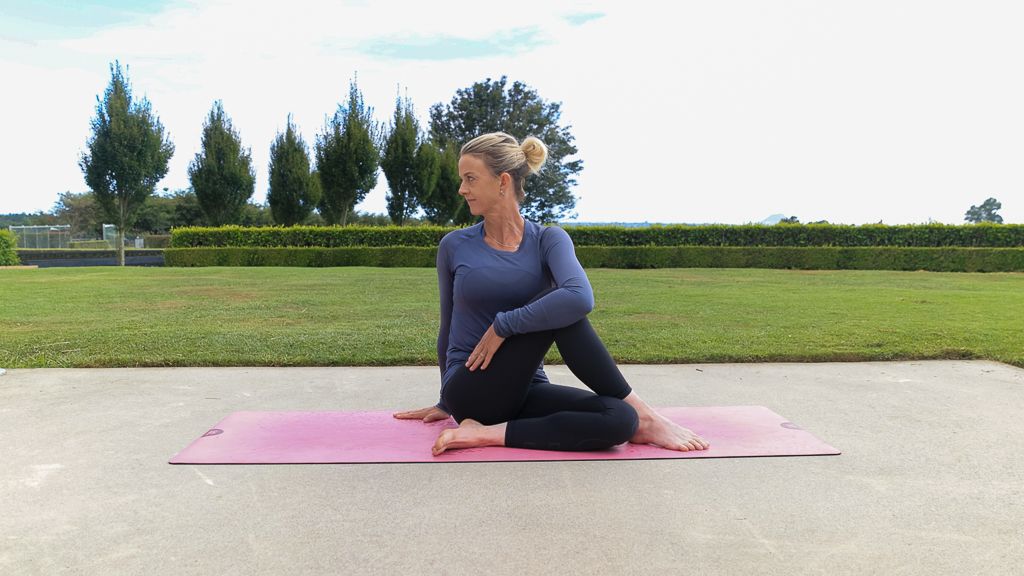
Begin on your hands and knees.
Bring one knee forward behind the wrist on the same side.
Allow the shin to rest at a comfortable angle in front of you.
Extend the opposite leg behind you.
Aim to keep the pelvis facing forward as much as your current range allows.
Remain supported on your hands or lower your torso gradually when comfortable.
The front shin does not need to be parallel with the edge of a mat.
For many riders, a more angled shin is safer and more appropriate.
Hold for around 30 seconds before changing sides.
What to notice
Do you feel a stretch through the front glute rather than pressure in the knee?
Can you keep breathing?
Does one hip sit much farther from the floor?
Use support underneath the hip when needed.
Keyhole Stretch
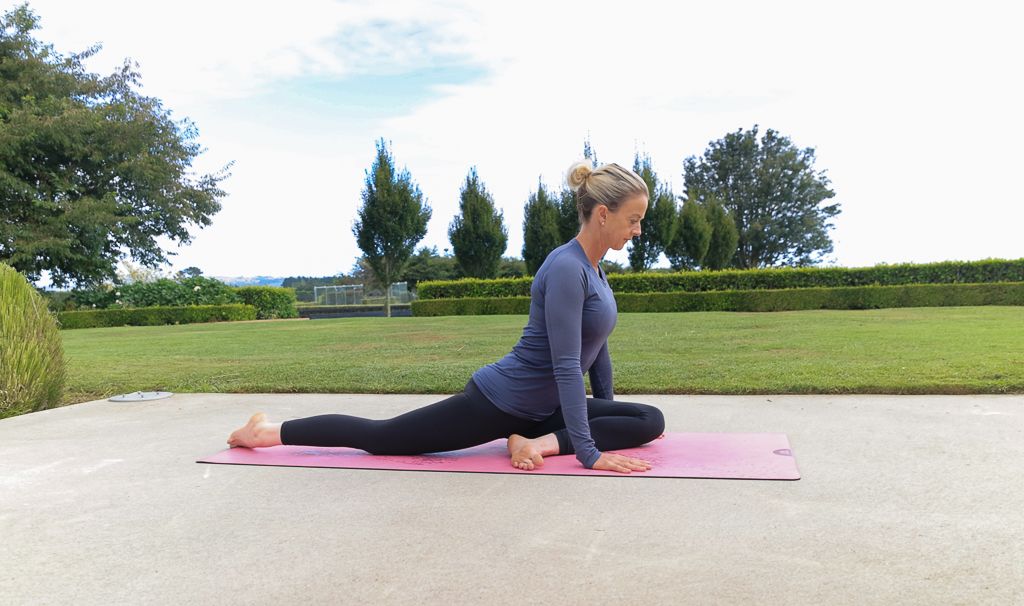
Lie on your back with both knees bent.
Cross one ankle over the opposite thigh.
Keep the foot flexed.
Reach around the supporting leg and gently draw it toward your chest.
Use a towel or strap behind the thigh if you cannot comfortably reach it.
You should feel the stretch through the glute and back of the crossed hip.
Hold for around 30 seconds, then change sides.
This is a useful alternative when pigeon pose feels too strong.
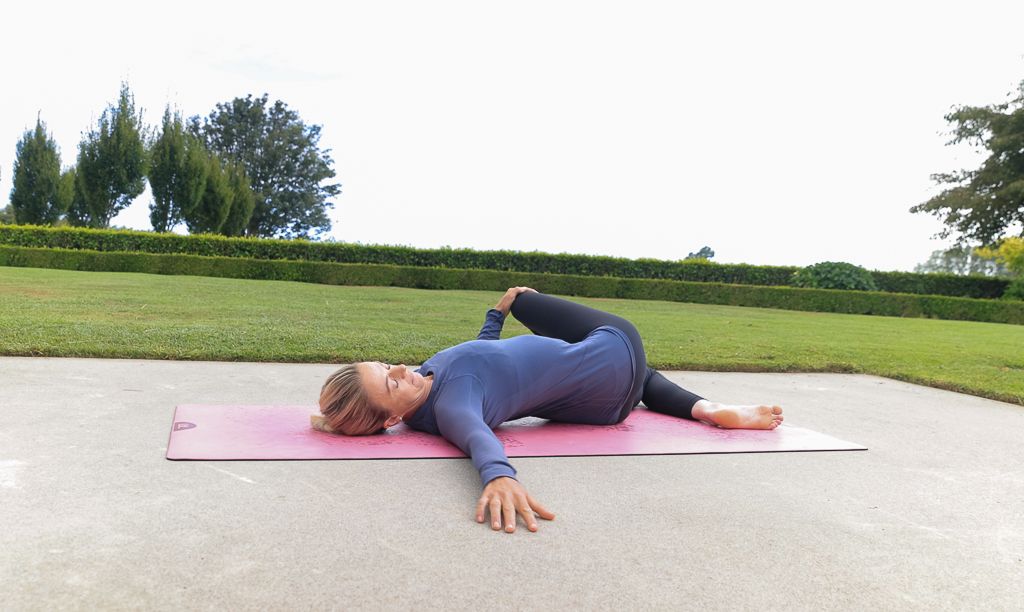
Supine Twist
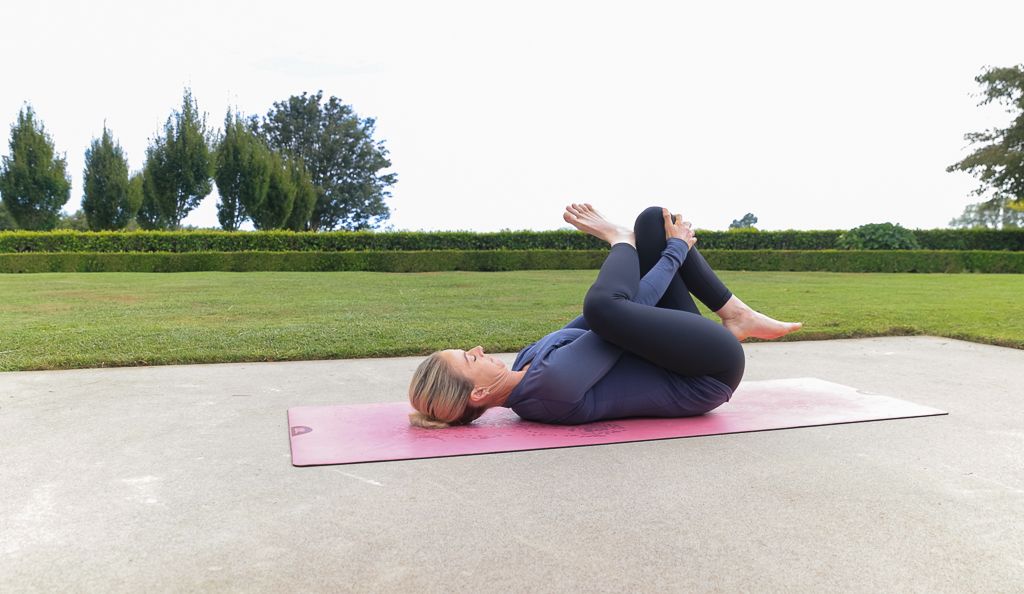
Lie on your back with both knees bent.
Allow one leg to cross over the body.
Let the hips and knees remain comfortably bent as the legs move toward the floor.
Keep the shoulders as relaxed as possible.
You may place one hand on the top knee to gently support the position.
Avoid forcing the knee downward.
Hold for around 30 seconds and repeat on the opposite side.
This position may create a stretch through the glutes, side of the hip and lower back.
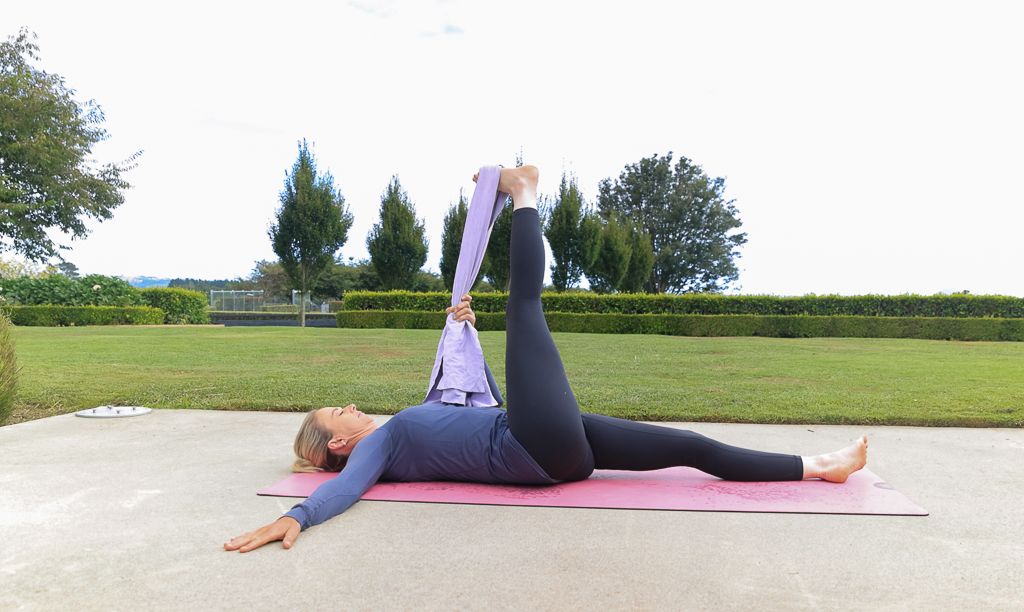
Supine-Assisted Outer-Hip Stretch
Lie on your back with a strap or long towel around one foot.
Lift the leg until you feel a comfortable stretch through the hamstring.
Keep the opposite arm extended out to the side for support.
Then guide the lifted leg gently across the body’s centre line.
Keep both shoulders grounded as much as possible.
Move only as far as you can without twisting or lifting the pelvis excessively.
Hold for around 30 seconds before changing sides.
You may feel this through the outer hip, glutes and back of the leg.
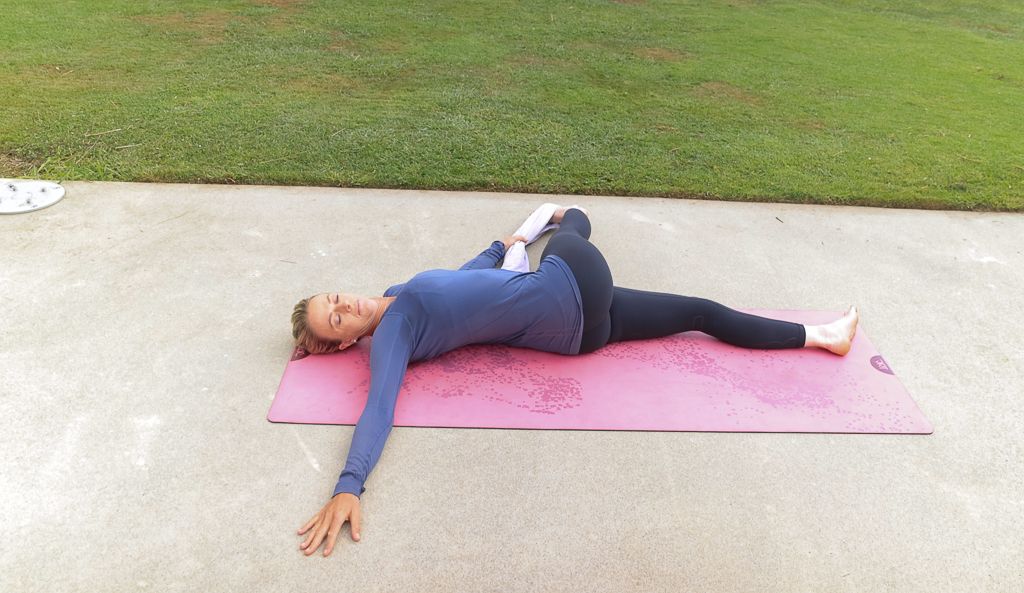
Supine-Assisted Twist
Lie on your back with a strap around one foot.
Bring the leg across the body with the knee initially bent.
Gradually straighten the knee until you find a manageable stretch.
The closer the leg moves toward a right angle with the body, the stronger the position may become.
Begin with the leg lower and progress gradually.
Hold for around 30 seconds and change sides.
The aim is not to force the foot toward the floor.
Keep the movement controlled.
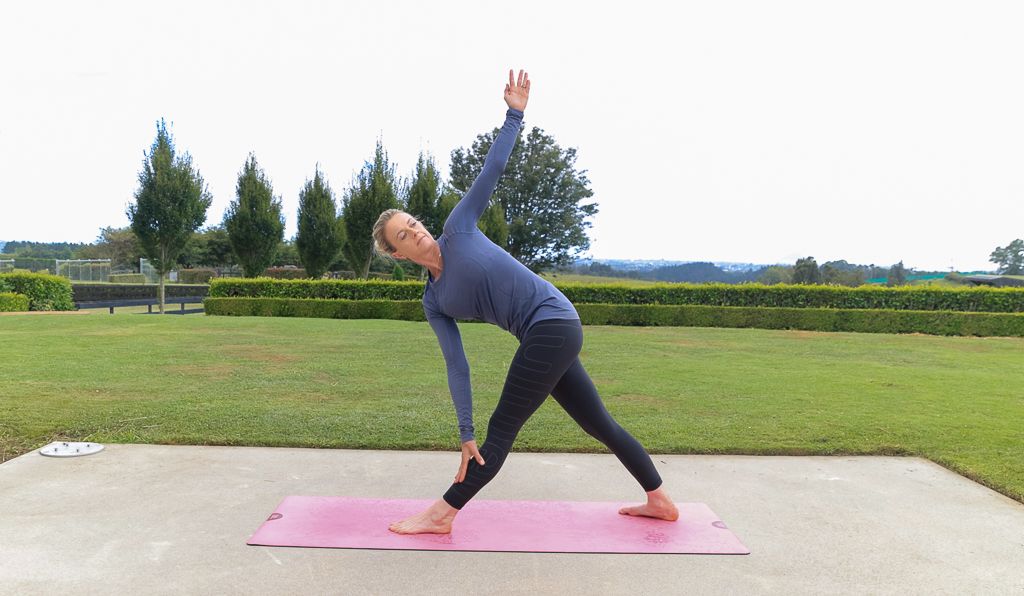
Twisted Triangle
Stand with your feet separated as though they are on two railway tracks rather than one tightrope.
Step one foot forward.
Turn your torso toward the front leg.
Place the opposite hand on the shin, a block or the ground.
Reach the other arm upward and rotate through the upper spine.
Keep the hips as organised as possible.
You may feel the stretch through the hamstring, glute and outside of the hip.
Hold for around 30 seconds, then change sides.
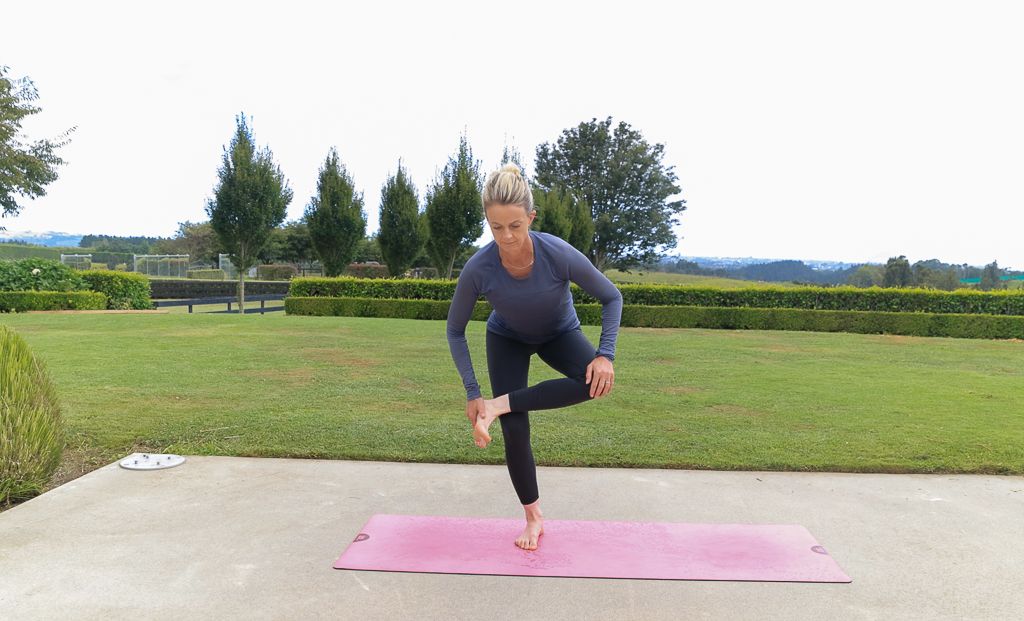
Standing Figure-Four Stretch
Stand beside a wall, stable surface or bench for balance.
Cross one ankle over the opposite thigh.
Flex the crossed foot.
Bend the supporting knee and send the hips backward as though sitting into a chair.
Keep the spine long.
You should feel the stretch through the glute and back of the crossed hip.
Hold for around 30 seconds and change sides.
You do not need to balance without support.
Using a wall allows you to focus on the quality of the hip position rather than fighting to stay upright.
Which Stretch Should You Choose?
You do not need to perform all eight.
One or two positions may feel particularly useful for your body.
Another stretch may feel uncomfortable or create pressure in the knee.
Choose the versions that allow you to:
- breathe steadily
- remain in control
- feel the stretch in the intended area
- avoid sharp pain or joint pinching
- compare the two sides clearly
The goal is not to collect as many stretches as possible.
It is to find the movements that help you understand and improve your own pattern.
How Long Should You Hold the Stretches?
Begin with around 20 to 30 seconds per side.
That may be enough before riding or when the position is new.
Longer holds can be used in a dedicated suppleness session when they feel appropriate.
Consistency matters more than one intense session.
Use a manageable position, breathe steadily and give the body time to adapt.
Symmetry Does Not Mean Identical
The aim is not to make both sides feel perfectly identical overnight.
Every rider has differences.
The goal is to understand the differences that affect your position, comfort and clarity in the saddle.
Perhaps one side feels:
- tighter
- weaker
- less stable
- more externally rotated
- harder to balance on
- more difficult to release
That information helps guide your training.
You may spend slightly more time on the restricted side.
You may need to strengthen the less stable side.
Or you may simply need to become more aware of how that difference shows up when you ride.
Symmetry is not perfection.
It is a gradual reduction in the imbalances that interfere with communication.
Stretching Is Only One Part of the Solution
The deep six help stabilise and control the hip.
So while suppleness matters, these muscles also need strength and coordination.
Useful training may include:
- single-leg bridges
- controlled step-ups
- split squats
- single-leg balance work
- clams
- side-plank variations
- single-leg hinges
- controlled hip-rotation exercises
The aim is not to isolate the deep six perfectly.
It is to build a stronger, more coordinated hip system.
A hip that can move.
A pelvis that can remain organised.
A thigh that can respond without gripping.
Take the Awareness Into the Saddle
Once you mount, notice how the hips and thighs feel.
Can you feel both seat bones?
Does one thigh rotate outward more?
Does one knee sit farther from the saddle?
Does one foot turn outward?
Does one side grip when the horse’s movement becomes larger?
Do not force an immediate correction.
Begin by noticing.
Then allow the thighs to soften around the horse while maintaining gentle support through the trunk.
See whether the position changes after your hips feel warmer.
The off-horse work is valuable because it helps you understand what your body is bringing into the saddle.
Your Body Is Part of What You Feel
Riders spend years developing feel.
We learn to notice whether the horse is falling through a shoulder.
Whether one hind leg feels less active.
Whether the contact is even.
Whether the horse is bending equally.
But our own bodies influence that information.
A restricted hip may make one side of the horse feel different.
Uneven seat pressure may change the horse’s response.
A thigh that rotates outward may affect how clearly the leg lies against the horse.
Understanding your body does not make your feel less trustworthy.
It makes it more informed.
The clearer you are about your own patterns, the better you can separate what belongs to you, what belongs to the horse and what is being created between the two of you.
The Deep Six Are Small—but They Are Part of a Bigger Picture
The deep six muscles play a useful role in hip rotation and stability.
They influence how the thigh is controlled within the socket and can contribute to differences between the two sides.
But they are not a hidden switch that fixes every rider problem.
They work as part of a larger system involving the glutes, adductors, hamstrings, hip flexors, trunk and pelvis.
This is why whole-body rider training matters.
We do not need to isolate every muscle.
We need to improve how the system works together.
More freedom where the body is restricted.
More support where it feels uncertain.
More awareness of the differences between the sides.
And less need to grip, brace or compensate.
Where to Begin
When one hip feels tighter, one thigh rotates outward or one seat bone feels harder to connect with, begin with curiosity rather than criticism.
Explore a few of the stretches.
Notice the difference between sides.
Then add strength work that helps you control the range you are creating.
This is exactly what we focus on inside Dressage Rider Training.
The Hip Suppleness Program helps riders improve freedom, symmetry and awareness through the hips.
The Strength Roadmap then builds the support needed to control that range and use it more confidently in the saddle.
Because lasting change is not simply about stretching what feels tight.
It is about creating a body that is both free enough to move and strong enough to support the movement.