Why a tight or overworked psoas can influence your posture, sitting trot and ability to move with your horse
When we ride with a balanced pelvis and an organised spine, our body is better able to respond to the horse’s movement.
Our hips can move.
Our torso remains supported.
Our seat bones can stay connected to the saddle without being pushed downward.
And the forces travelling through the horse’s back can pass through us with less resistance.
But when the muscles around the front of the hips feel tight, overworked or poorly coordinated, finding that balance can become frustrating.
You may feel as though your pelvis is constantly tipping or tucking.
Your lower back may tighten.
One leg may creep forward.
You may bounce in sitting trot or struggle to follow the horse without bracing.
No matter how much you try to sit deeper or relax, your body seems to return to the same pattern.
One of the muscles that can influence this is the psoas.
The psoas is often described simply as a hip flexor, but its role is more complex than that.
Because it connects the spine to the thigh bone, it can influence the relationship between your trunk, pelvis and legs—all areas that matter enormously when you ride.
What Is The Psoas?
You have a psoas muscle on each side of your body.
It begins along the lower part of the spine, travels through the pelvis and joins with another muscle called the iliacus before attaching to the upper part of the thigh bone.
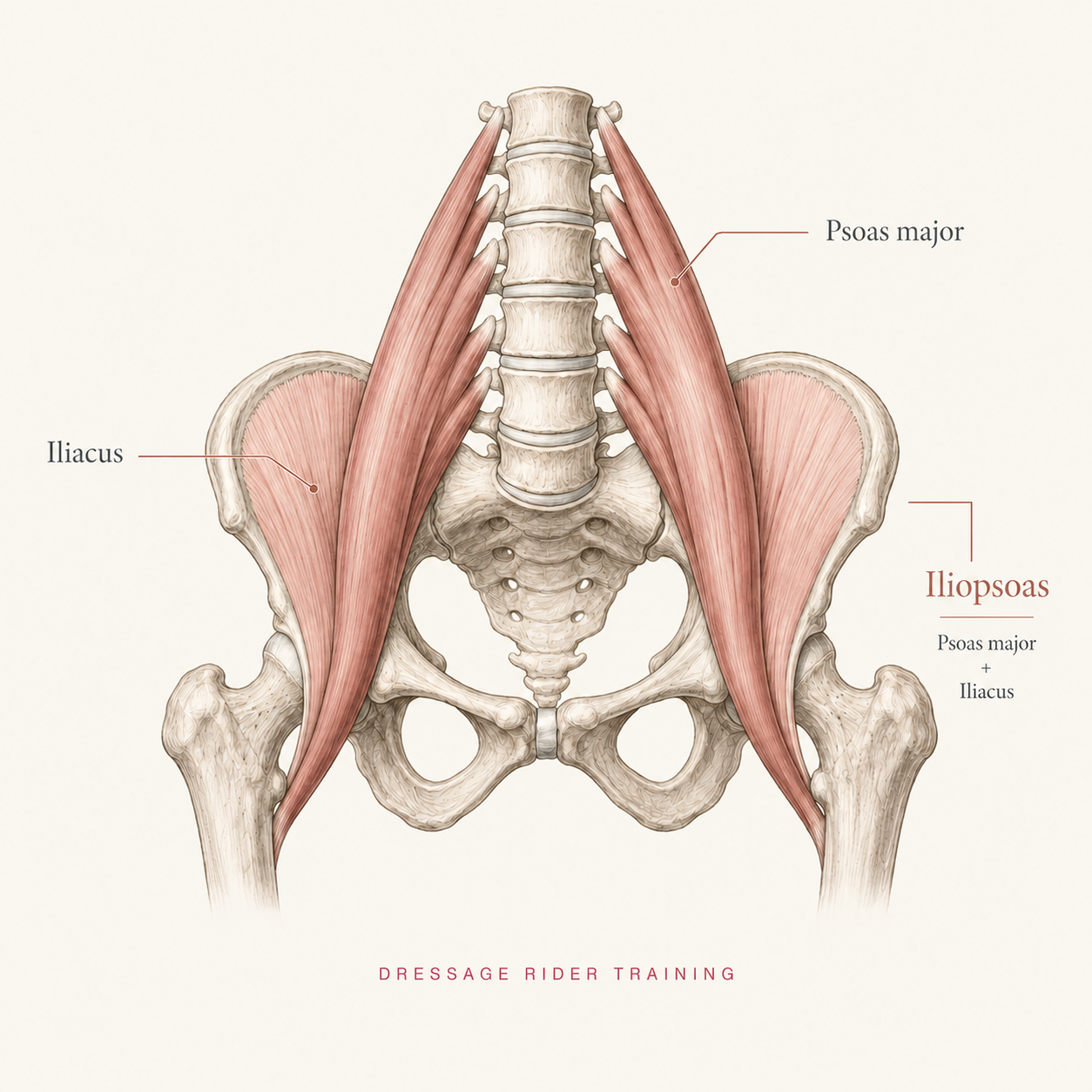
Together, these muscles are often referred to as the iliopsoas.
The psoas helps with movements such as lifting the thigh, bending at the hip and stabilising the spine and pelvis during movement.
But it does not work alone.
It coordinates with the abdominals, diaphragm, back muscles, glutes and other muscles around the hips.
This matters because pelvic stability is not created by one muscle holding the pelvis perfectly still.
It is created by a group of muscles working together to keep you supported while still allowing movement.
That distinction is especially important for riders.
Your pelvis should not be rigid.
It needs to remain balanced and responsive as the horse moves beneath you.
Pelvic Stability Does Not Mean A Fixed Pelvis
The word stability can easily be misunderstood.
Many riders hear “stabilise your pelvis” and respond by tightening their abdominals, clenching their glutes or trying to hold the pelvis completely still.
But the horse is moving.
A pelvis that is locked into place cannot follow that movement well.
True stability is not stiffness.
It is the ability to remain organised while movement happens.
Your pelvis needs enough control that it is not being thrown around with every stride, but enough freedom to respond to the rhythm of the horse.
The psoas can play a role in this balance.
When it is functioning well as part of the wider system, it can help support the relationship between the spine, pelvis and thigh.
When it becomes excessively tense, overworked or poorly coordinated, it can influence the position of the pelvis and reduce the freedom available through the hip.
How The Psoas Can Affect Your Position In The Saddle
Because the psoas connects the lower spine to the thigh bone, changes in its tone or function can influence both ends of that connection.
If one or both sides are consistently tense, you may notice:
- difficulty allowing the thigh to move behind you
- a tendency for the leg to creep forward
- tightness through the front of the hip
- discomfort or bracing through the lower back
- difficulty sitting evenly on both seat bones
- one side of the pelvis feeling more restricted
- trouble following the movement in sitting trot
- a tendency to tip, tuck or twist the pelvis
This does not mean the psoas is always the cause.
The body is more complex than that.
A tense psoas may be responding to poor trunk support, prolonged sitting, stress, weakness elsewhere or a lack of confidence in a particular range.
Sometimes it is working too hard because other muscles are not contributing enough.
This is why simply stretching the psoas is not always the complete solution.
The aim is not just to make it longer.
The aim is to improve the way it works with the rest of your body.
Why Sitting Can Influence The Psoas
Many riders spend a large part of the day sitting.
We sit at a desk.
We sit in the car.
We sit on the sofa.
Then we get on a horse and ask our hips to move freely in a wide, open position.
When you sit for long periods, the hips remain flexed.
Over time, the muscles at the front of the hips may become accustomed to working within that shortened position.
But sitting does not affect everyone in exactly the same way.
You may habitually cross one leg over the other.
Lean toward one side in the car.
Sit with one foot tucked underneath you.
Rotate toward a computer screen.
Carry an old injury or compensation from years ago.
These patterns can create differences between the left and right sides.
One psoas may feel more active or restricted than the other.
One hip may extend more easily.
One side of the pelvis may feel more stable.
These asymmetries can follow you into the saddle.
You may then notice one leg creeping forward, one seat bone feeling heavier or one rein feeling much harder to organise.
Why A Restricted Hip Can Affect Sitting Trot
At sitting trot, the pelvis and hips need to respond rapidly and repeatedly to the horse’s movement.
Your thigh bones need to move within the hip sockets while your torso remains supported above them.
If the front of the hip feels restricted, your body may struggle to allow the thigh to move freely.
It then looks for movement elsewhere.
You may lean backward.
Arch or brace your lower back.
Tuck the pelvis underneath you.
Grip with the thighs.
Rock excessively through the torso.
These are compensation strategies.
The body is trying to create enough movement to stay with the horse, but it is borrowing that movement from areas that are less suited to provide it.
This can make sitting trot feel stiff, effortful and difficult to sustain.
It can also make the rider feel as though they need to try harder, when what they may actually need is more freedom and better support.
The Psoas And The Neutral Pelvis
A neutral pelvis is not one exact shape that every rider must force themselves into.
It is a balanced position where the pelvis is not excessively tipped forward, tucked underneath or rotated to one side.
From this position, the spine can remain organised and the hip joints have a better opportunity to move.
The psoas can influence this relationship because of its connection to both the spine and thigh bone.
But it is important not to think of the psoas as pulling the pelvis into one predictable position in every person.
Bodies are different.
Muscles adapt differently.
And pelvic position is influenced by many structures and habits, not one muscle alone.
Instead of trying to diagnose whether your psoas is “short” or “tight,” it can be more useful to notice what your body is doing.
Can your thigh move behind you without your lower back arching?
Can you sit evenly on both seat bones?
Can you maintain your posture without gripping the front of your hips?
Can you move one leg independently without the whole pelvis shifting?
These questions give you more practical information than simply labelling one muscle as the problem.
Why Stretching Alone May Not Fix The Problem
Stretching the front of the hips can feel wonderful.
It may create an immediate sense of space.
Your stride may feel longer.
Your pelvis may settle more easily.
But if your body does not feel strong or secure in that new range, it may quickly return to the position it knows best.
The body returns to what it can support.
This is why suppleness work is most effective when it is followed by strength and control.
You may need to improve:
- the ability of the glutes to contribute to hip extension
- abdominal support around the trunk and pelvis
- control of the pelvis as the leg moves
- strength through the hips at longer muscle lengths
- coordination between breathing, the trunk and the hips
- awareness of differences between your left and right sides
Suppleness creates more room.
Strength helps your body use that room and live there.
The Role Of The Glutes And Abdominals
The psoas is only one part of pelvic stability.
The glutes help control the hips and support the pelvis, particularly when the thigh moves behind the body.
The abdominals help organise the relationship between the ribcage, spine and pelvis.
When these areas are not contributing effectively, the psoas and other hip flexors may work harder to create security.
This can lead to the front of the hips feeling constantly “on.”
But the solution is not to switch the psoas off.
You need it.
The solution is to improve the teamwork.
When the trunk is supported and the glutes can contribute, the psoas no longer has to do everything.
The pelvis can remain more balanced.
The hips can move with less compensation.
And the rider may find it easier to follow the horse without gripping or leaning.
Breathing Matters Too
The psoas sits deep within the body and works in close relationship with the diaphragm and muscles surrounding the spine.
This is one reason stress and breathing can influence tension around the hips.
When you are anxious, holding your breath or trying very hard in the saddle, the entire central area of the body may become braced.
The abdominals tighten.
The diaphragm becomes less mobile.
The hips stiffen.
The lower back may begin to work harder.
A slow, steady exhale can sometimes help reduce unnecessary tension and reconnect you with your body.
But breathing alone cannot replace strength or suppleness.
It is one part of helping the system become more coordinated.
Signs Your Pelvic Stability May Need Work
You may benefit from improving the relationship between your psoas, hips and pelvic stability if you notice:
- you struggle to sit evenly on both seat bones
- one leg regularly moves farther forward
- one hip feels much tighter than the other
- you lean back to sit to the trot
- your lower back becomes tight while riding
- your thighs grip when the movement becomes bigger
- your pelvis rocks excessively with each stride
- you struggle to move one leg without moving your whole body
- your position improves temporarily after stretching but quickly returns
None of these signs proves that the psoas is the problem.
They simply suggest that the way your trunk, pelvis and hips are working together may deserve attention.
What To Work On Off The Horse
You do not need to memorise anatomy or diagnose every muscle in your body.
But it is useful to understand how your daily habits influence your riding.
A balanced approach may include:
Hip Suppleness
Gentle stretches can help create more space through the hips.
The goal is not to force the pelvis forward or create a large backbend.
Keep the pelvis organised and look for a controlled stretch rather than maximum range.
Glute Strength
Strengthening the glutes can improve the body’s ability to extend the hip without relying excessively on the lower back.
This may help the leg sit more comfortably beneath you rather than creeping forward.
Deep Abdominal Control
Rider-specific abdominal work can help support the spine and pelvis as the legs move.
This should not feel like bracing everything as hard as possible.
The aim is controlled support with continued breathing.
Independent Leg Movement
Practise moving one thigh at a time while keeping the pelvis relatively quiet.
This can improve your ability to use your legs independently when riding.
Left-To-Right Awareness
Notice whether one side feels stronger, tighter or less controlled.
Work with the body you have rather than forcing both sides to look identical immediately.
Knowledge Gives You Better Options
This is something I continue to work on in my own body.
That is part of riding.
Your seat is not a final destination you arrive at.
It develops throughout your riding life as your awareness, body, horses and goals change.
The value of understanding your body is not that you become obsessed with every muscle.
It is that you can begin to problem-solve more effectively.
Instead of assuming that bouncing means you need to sit more trot, you can ask whether your hips have enough freedom.
Instead of forcing your leg backward, you can look at what may be preventing the hip from extending.
Instead of blaming yourself for being crooked, you can begin improving the patterns that make one side feel different.
Knowledge gives you options.
And the more options your body has, the less it needs to grip, brace or compensate.
Pelvic Stability Is Supported Movement
The goal is not to hold your pelvis perfectly still.
It is to create enough support that it can remain balanced while responding to the horse.
The psoas contributes to this, but it does not work alone.
Your abdominals, glutes, spine, breathing and hips all play a role.
When these areas begin working together, your body can become both steadier and softer.
Your hips can follow the horse.
Your torso can remain organised.
Your seat can stay connected without being forced downward.
This is the kind of strength we want as riders.
Not strength that makes us rigid.
Strength that creates support, availability and freedom.
Improve Your Body Off The Horse
Inside Dressage Rider Training, we work on the suppleness, strength, balance and control that influence how your pelvis and hips function in the saddle.
The aim is not to chase perfect posture or blame one tight muscle for every problem.
It is to help you understand your body, improve its options and create a seat that is organised enough to soften.
Because when your body has both support and freedom, it becomes much easier to move with your horse rather than against them.