Understand the 20 × 40 and 20 × 60 metre arenas, where every letter belongs and how to set up your own arena accurately.
The first time you look at a dressage arena, the letters can seem completely random.
A, K, V, E, S, H…
Why those letters?
Why are they not in alphabetical order?
And how are riders expected to remember where every movement begins and ends?
The layout becomes much easier once you understand what the letters are actually doing.
They divide the arena into clear reference points so riders, trainers and judges can describe exactly where a movement should happen.
You enter at A.
Ride down the centre line toward C.
Turn at E or B.
Begin a diagonal at H, M, K or F.
The letters turn an otherwise empty rectangle into a shared language.
And in dressage, where accuracy can influence every movement, knowing that language matters.
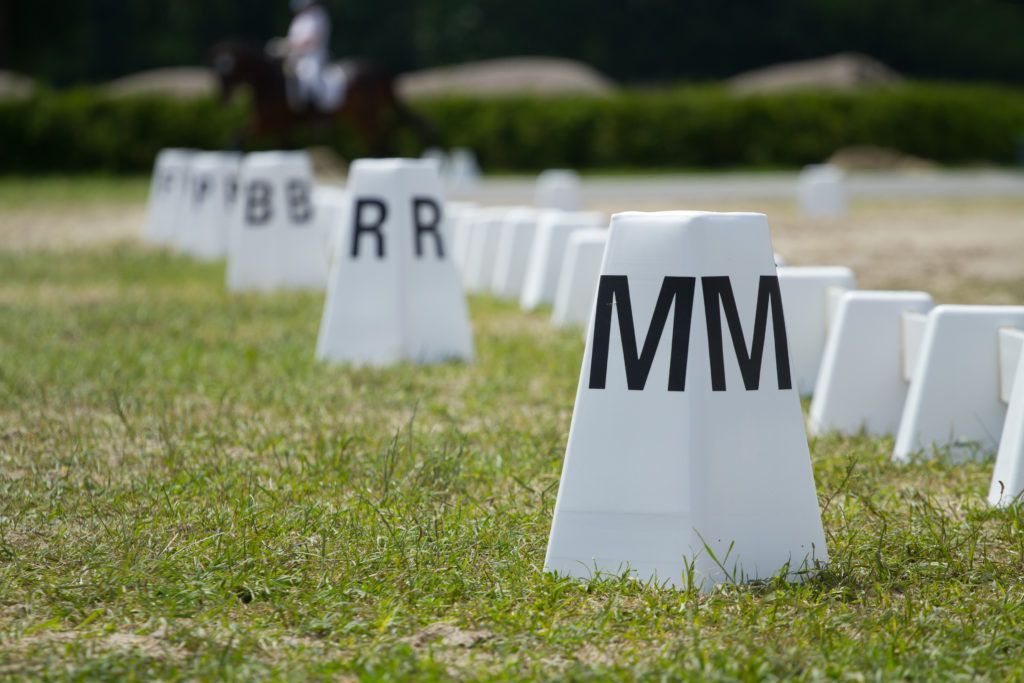
Why Dressage Arena Letters Matter
The arena letters are not simply there to help you remember a test.
They help you ride with greater precision.
A transition may be required at a particular letter.
A circle may begin at one marker and finish at another.
A diagonal line needs to leave the track at the correct point and arrive accurately on the opposite side.
When you understand the layout, you can prepare movements rather than reacting at the last moment.
You begin using the corners more effectively.
Your lines become straighter.
Your circles become more accurately shaped.
And your test begins to look intentional rather than approximate.
The letters also give riders, coaches and judges a consistent way to communicate.
Instead of saying, “Make the transition somewhere along the long side,” your trainer can say, “Prepare at V and transition at E.”
Everyone knows exactly where that is.
The Two Dressage Arena Sizes
There are two commonly used dressage arena dimensions:
- Small arena: 20 × 40 metres
- Standard or large arena: 20 × 60 metres
The arena is always 20 metres wide. The difference is its length and the number of letters used along the long sides and centre line.
International FEI dressage competition uses the 20 × 60 metre arena. The arena required for a particular national, para-dressage or lower-level test can vary, so always check the current test sheet and the rules for the competition you are entering.
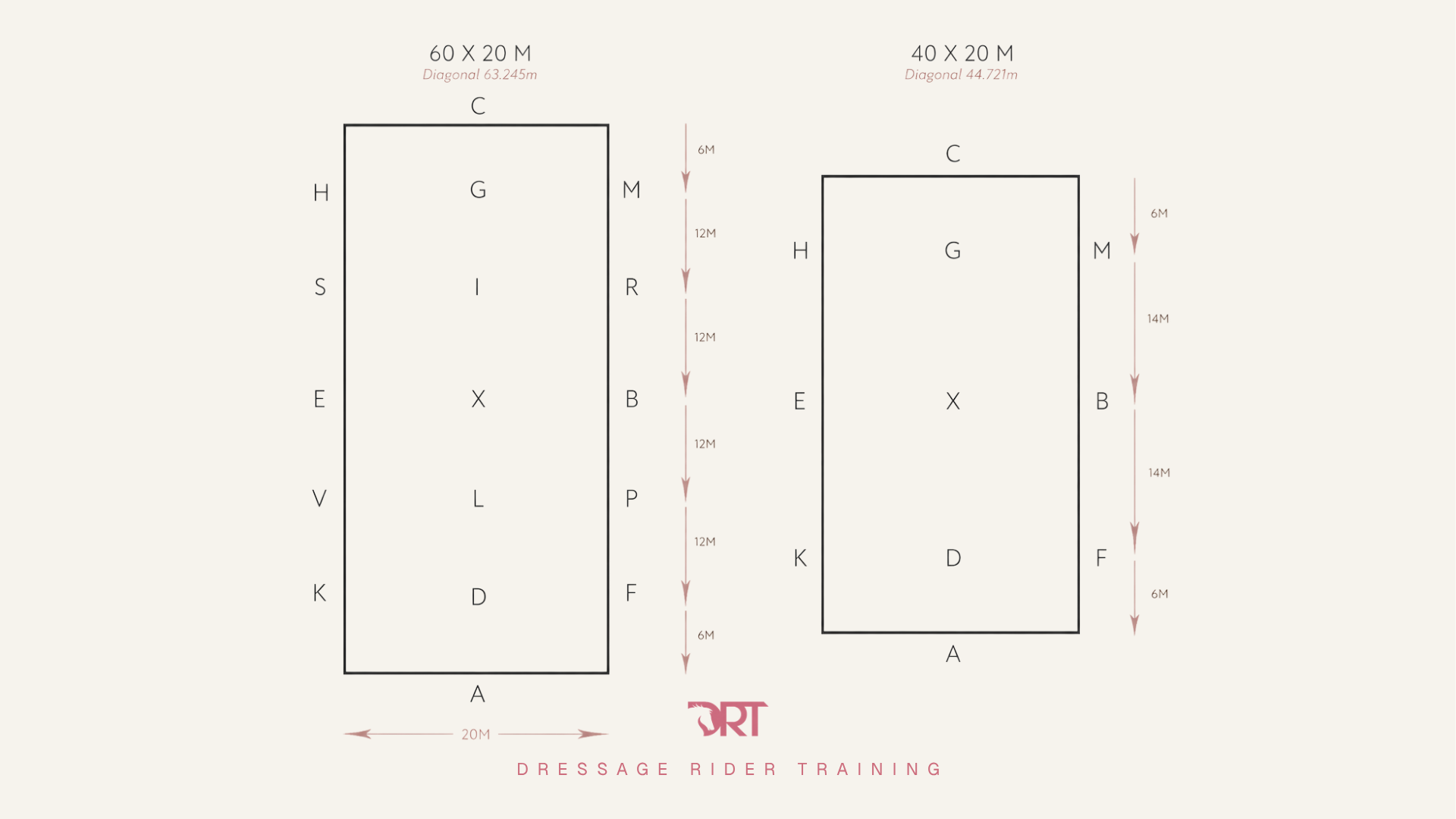
The small dressage arena: 20 × 40 metres
The outside letters are:
A – K – E – H – C – M – B – F
Starting at A and travelling clockwise:
- A sits in the centre of the first short side
- K, E and H run along the left long side
- C sits in the centre of the opposite short side
- M, B and F run along the right long side
The invisible centre-line letters are:
D – X – G
The standard dressage arena: 20 × 60 metres
The outside letters are:
A – K – V – E – S – H – C – M – R – B – P – F
Starting at A and travelling clockwise:
- A sits in the centre of the entrance short side
- K, V, E, S and H run along the left long side
- C sits in the centre of the opposite short side
- M, R, B, P and F run along the right long side
The invisible centre-line letters are:
D – L – X – I – G
In both arenas, X marks the exact centre.
The Outside Letters Versus the Centre-Line Letters
The letters around the outside of the arena are physical markers.
You can see them as you ride.
The centre-line letters are different.
They describe exact points inside the arena, but there are not usually physical signs standing in the middle of your test.
You need to learn where they sit by relating them to the outside markers.
In the large arena:
- D lies between A and X
- L is level with V and P
- X is level with E and B
- I is level with S and R
- G lies between X and C
This matters because many movements begin, finish or pass through those invisible points.
For example:
- entering at A and halting at X
- riding a ten-metre circle from E through X
- completing a half-pass toward G
- riding a centre line from C through X to A
The more familiar you become with the internal geometry, the less the arena feels like a collection of unrelated letters.
It becomes a grid.
Dressage Arena Letter Order
Small arena
Starting at A and moving clockwise:
A – K – E – H – C – M – B – F
Large arena
Starting at A and moving clockwise:
A – K – V – E – S – H – C – M – R – B – P – F
It is worth learning the sequence in both directions.
During a test, you may be tracking left or right, and the letters will arrive in a different order depending on which way you are travelling.
Do not rely only on reciting the complete sequence from A.
Practise visualising:
- the A end
- the C end
- the E side
- the B side
- each corner letter
- the letters opposite one another
This makes the layout far easier to use while you are riding.
Which Dressage Letters Sit Opposite One Another?
In the 20 × 60 metre arena, these pairs sit directly opposite one another:
- K and F
- V and P
- E and B
- S and R
- H and M
In the 20 × 40 metre arena:
- K and F
- E and B
- H and M
Learning the opposite pairs is one of the quickest ways to understand diagonals, circles and straight lines across the school.
For example:
- H to F is a long diagonal
- M to K is the opposite long diagonal
- E to B crosses directly through X
- a circle ridden from E should return accurately to E
What Do the Dressage Arena Letters Mean?
The honest answer is that no definitive explanation for the original choice of letters has been proven.
Several stories have been repeated over the years, and most connect the system to German or Prussian military and court stables.
The best-known theory suggests that letters marked positions in the Royal Manstall or imperial stables, identifying where horses belonging to different members of the court should wait.
A commonly shared version links letters with German titles or roles, including:
- K – Kaiser, or Emperor
- F – Fürst, or Prince
- P – Pferdeknecht, or groom
- V – Vassal
- R – Ritter, or knight
- M – Meier, or steward
It is an interesting story, but it should be treated as a theory rather than established fact. Historical accounts agree that the precise origin of the modern letter sequence remains uncertain.
For riders today, the practical meaning of each letter is more important than its historical origin.
The letters tell you where you are, where you are going and where a movement needs to happen.
How to Remember the Dressage Arena Letters
A mnemonic can make the outside letters much easier to learn.
For the basic sequence:
A – K – E – H – C – M – B – F
one of the most familiar sayings is:
All King Edward’s Horses Can Make Big Fences
Other versions include:
All King Edward’s Horses Can Move Beautifully Forward
or the less elegant—but often more memorable:
All King Edward’s Horses Can Make Big Farts
The best mnemonic is the one you will actually remember.
For the full 20 × 60 metre arena, you then need to add:
V and S on the E side
R and P on the B side
But I would not rely on a sentence alone.
The letters become much easier when you learn them as a shape:
- A and C anchor the short sides
- E and B mark the middle of the long sides
- K, H, M and F sit nearest the corners
- V and S fill the left long side
- R and P fill the right long side
- X sits in the centre
This turns memorisation into orientation.
A Simple Way to Learn the Large Arena
Start with the six easiest markers:
A – C – E – B – X
A and C are the ends.
E and B are the middle of the long sides.
X is the centre.
Then add the four corner markers:
K – H – M – F
Finally, add the remaining four letters:
V – S – R – P
This is much less overwhelming than trying to memorise twelve outside letters at once.
You can also draw the arena repeatedly from memory.
It may seem basic, but sketching it several times helps create a mental map you can access while riding.
Where the Letters Are Positioned in a 20 × 60 Arena
In a standard 60-metre arena:
- K, H, M and F are 6 metres from the nearest corner
- the remaining long-side intervals are 12 metres
- E and B sit halfway along the long sides
- A and C sit halfway across the short sides
The standard sequence along one long side is:
K — 12 m — V — 12 m — E — 12 m — S — 12 m — H
There are 6 metres from the first and last letters to their nearest corners.
The opposite side mirrors it:
F — 12 m — P — 12 m — B — 12 m — R — 12 m — M
The standard letters nearest the corners being 6 metres in, followed by 12-metre spacing, is reflected in arena setup guidance.
Where the Letters Are Positioned in a 20 × 40 Arena
In the small arena:
- K, H, M and F are 6 metres from the nearest corner
- E and B sit at the midpoint of the long sides
- the distance from K to E and E to H is 14 metres
- A and C remain centred on the short sides
The sequence along one long side is:
K — 14 m — E — 14 m — H
And on the opposite side:
F — 14 m — B — 14 m — M
How to Set Up a Dressage Arena Accurately
Whether you are building a permanent arena or marking one temporarily on a grass field, measure carefully.
A small error at the beginning can leave the entire arena out of square.
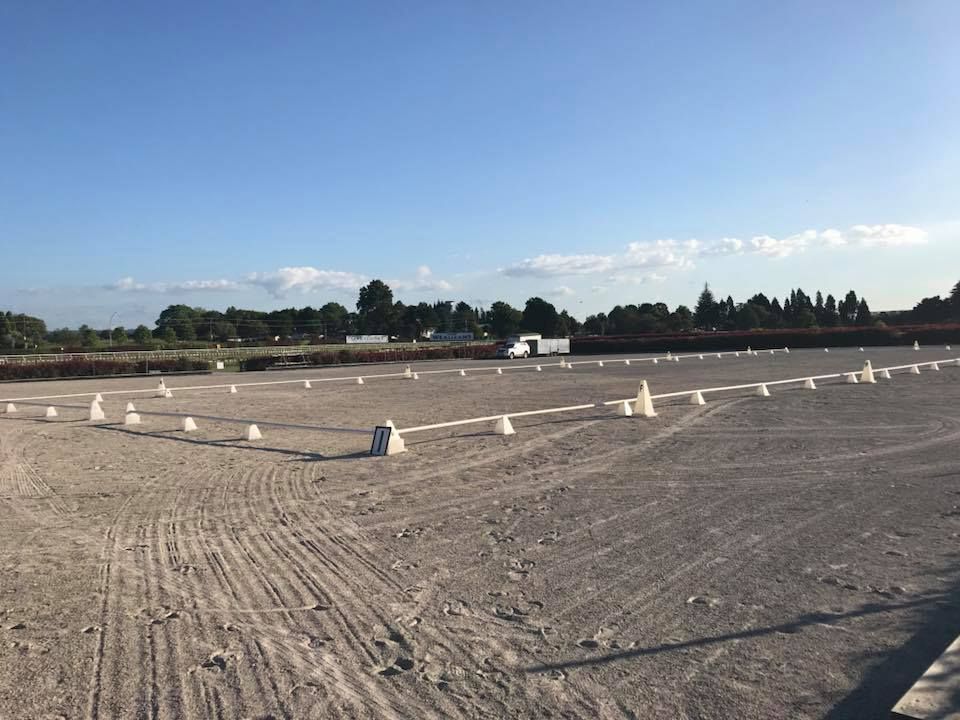
Step 1: Choose the location
Select a flat, safe area with consistent footing.
The surface should offer traction without being excessively hard, deep, slippery or uneven.
Allow additional space around the outside for letters, judges, access and safe movement.
Step 2: Mark the first long side
Measure either 40 or 60 metres, depending on the arena you are building.
Place a marker at each end.
This first line becomes the foundation for the rest of the layout.
Step 3: Create a right angle
From each end of the first long side, measure 20 metres at a true right angle to establish the short sides.
Do not rely on your eye alone.
A slightly incorrect angle can create a parallelogram rather than a rectangle.
Step 4: Measure the opposite long side
Join the two new points and check that the opposite long side measures exactly 40 or 60 metres.
Step 5: Check the diagonals
This is the easiest way to confirm that the arena is square.
For a 20 × 40 metre arena, both corner-to-corner diagonals should be approximately:
44.72 metres
For a 20 × 60 metre arena, both diagonals should be approximately:
63.25 metres
When both diagonals are equal, your corners are square.
Step 6: Install the boundary
You can use:
- a purpose-made portable dressage arena
- low white boards
- rails
- poles
- cones and a string line for informal training
For competition, follow the current requirements of the organising body rather than assuming a home-training setup will meet event specifications.
Step 7: Position A and C
Place A at the centre of one short side and C at the centre of the opposite side.
In many arenas, A is also the entrance point.
Step 8: Measure the long-side letters
Do not space them by eye.
Use a tape measure and mark every position accurately according to the arena size.
Place the visible letter board just outside the boundary and mark the exact corresponding point on the arena rail if possible.
Step 9: Identify the centre line
Run a temporary string from A to C when first setting up the arena.
Mark X at the midpoint:
- 20 metres from A in the small arena
- 30 metres from A in the large arena
You can then establish the remaining invisible centre-line points.
Setting Up the Centre-Line Letters
In a 20 × 40 metre arena
Travelling from A toward C:
- D – 6 metres from A
- X – 20 metres from A
- G – 6 metres before C
In a 20 × 60 metre arena
Travelling from A toward C:
- D – 6 metres from A
- L – 18 metres from A
- X – 30 metres from A
- I – 42 metres from A
- G – 54 metres from A
You would not normally place physical markers on these points during a test.
But you can mark them during training with discreet cones beside the track, arena-board marks or visual references outside the arena.
Accuracy Is More Than Hitting a Letter
Riders sometimes think accuracy means making a transition exactly when the horse’s nose reaches the marker.
But the test directive may refer to the rider, the horse’s body or a movement being centred around a point.
Read the test carefully and listen to how your coach wants each movement prepared.
Good accuracy also includes:
- riding into the corners rather than cutting them
- making circles the correct size and shape
- keeping diagonals straight
- preparing transitions before the marker
- riding centre lines directly toward the judge
- completing movements before beginning the next one
The letter is the visible reference point.
The quality of the line leading to and away from it matters too.
Use the Arena to Improve Your Everyday Training
Arena accuracy is not only for competitions.
The letters can make your daily schooling much more deliberate.
You can use them to:
- make both reins more symmetrical
- measure circles accurately
- ride transitions at planned points
- check whether your horse drifts on diagonals
- compare how movements feel in both directions
- prevent yourself from riding endless, unplanned laps
For example:
Ride a transition at every second letter.
Practise ten-metre circles at E and B.
Ride centre lines from A and C.
Use quarter lines to check straightness.
Ride the same exercise at matching points on both reins.
The arena becomes a training tool rather than simply the place where you ride.
How Arena Accuracy Can Improve Your Test
Accuracy is one of the simplest areas to improve because it does not depend entirely on having a more advanced horse.
You can practise it at every level.
A well-prepared transition at the correct marker creates a clearer picture than one that happens several metres late.
A truly round circle shows better balance than an oval that drifts toward the track.
A straight centre line immediately gives the judge confidence in the partnership.
Accuracy also helps the horse.
When you prepare early and ride clear lines, you give your horse more opportunity to stay balanced.
You are not making abrupt corrections because a letter has suddenly arrived.
You know where you are going.
Your body becomes clearer.
Your aids become quieter.
And the test begins to feel like a connected sequence rather than a list of movements you are trying to remember.
The Arena Is a Map
A dressage arena is not simply a rectangle surrounded by strange letters.
It is a map.
A and C give you direction.
E, B and X establish the centre.
The corner letters organise your diagonals.
The remaining markers divide the long sides into measurable sections.
Once you understand that structure, the letters stop feeling random.
You begin to see lines, shapes and relationships.
And when you know where you are, you can prepare where you are going.
That is where accuracy begins.
Not at the letter itself.
But in the strides before it.
Improve the Rider Inside the Arena
Learning the layout helps you ride a more accurate test.
But accuracy also depends on your ability to stay balanced, organised and responsive while you ride it.
Your horse may drift because your weight shifts.
A circle may become uneven because one hip moves differently from the other.
A transition may arrive late because your body is still trying to reorganise itself.
This is why rider training matters.
Inside Dressage Rider Training, we help riders improve the suppleness, strength, balance and awareness that influence how clearly they ride every line and movement.
The goal is not simply to memorise the arena.
It is to become a rider who can use it with greater precision, softness and confidence.