There’s a moment every rider knows.
You ask for sitting trot…
and instead of feeling connected, you feel like you’re being gently — or sometimes not so gently — bounced out of the saddle.
So you try to fix it.
You try to relax.
You try to sit deeper.
You try to “go with the movement.”
And for a stride or two, maybe it almost feels like it’s working…
until it doesn’t.
And you’re back to feeling slightly out of sync.
What’s interesting is that most riders assume this is something they need to solve in the saddle.
But more often than not, what you’re feeling isn’t a riding issue.
It’s your body doing the best it can… with the options it currently has.
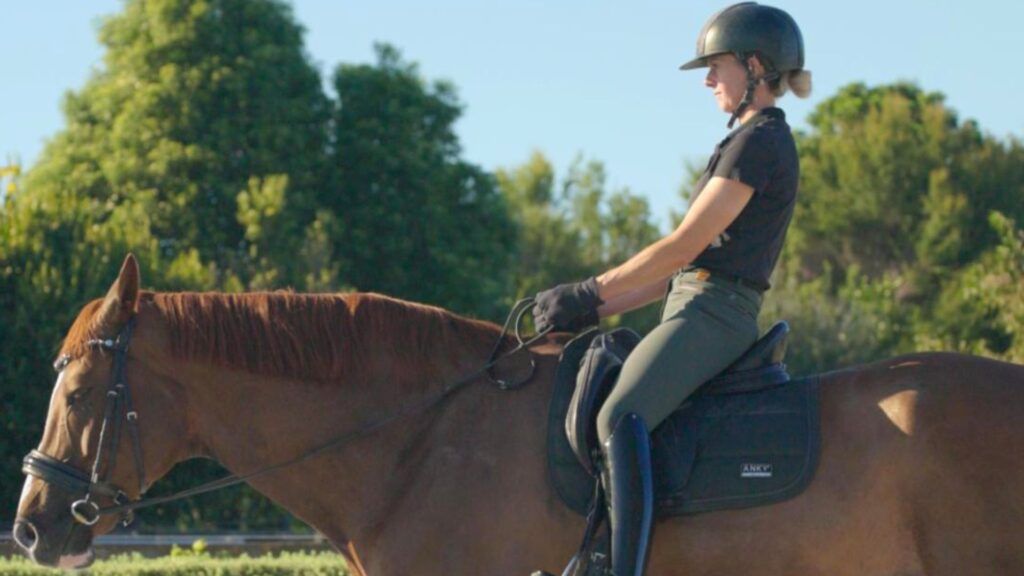
The Trot Doesn’t Lie
The trot is an honest gait.
It asks your body a very direct question:
Can you receive and organise movement… without resisting it?
Because every stride of trot creates force.
Upward.
Forward.
Rhythmic.
Consistent.
And that force has to go somewhere.
In a body that moves well, that force is absorbed, distributed, and recycled through the system.
The hips soften and respond.
The pelvis gently rotates.
The core organises and supports.
The breath flows.
But if there is restriction anywhere in that chain…
the system has to adapt.
And that adaptation is what you feel as bouncing.
Your Body Is Always Choosing Safety First
One of the most important things to understand is this:
Your body is not working against you.
It is working for you.
Always.
It's incredible.
If your hips are tight, your core is not supporting you, or your body doesn’t feel stable…
your nervous system will choose the strategy that feels safest.
And very often, that strategy is bracing.
Not because you’re doing anything wrong.
But because your body doesn’t yet trust that it can move freely and remain supported.
So instead of allowing movement to travel through you…
you hold.
And when you hold…
the movement has nowhere to go.
So it comes back up.
And that’s the bounce.
It Rarely Starts Where You Think
Most riders focus on the seat.
But the seat is simply the place where everything meets.
The real story is happening underneath that.
If the hips have lost their ability to move — which is incredibly common in modern life — then the pelvis can’t respond to the horse.
If the deep core isn’t quietly supporting from underneath,then the body has nothing to organise around.
And if those two pieces aren’t working together, the lower back will often step in and try to help.
But the lower back isn’t designed to absorb and organise movement like the hips are.
So it tightens.
It braces.
It protects.
And in doing so, it actually makes the whole system more rigid.
This is why you can feel like you’re trying to relax…but your body won’t let you.
Because from your body’s perspective, letting go doesn’t feel safe yet.
What Changes When It Starts to Work
There’s a moment — and it’s often quite subtle — where things begin to shift.
You’re still in sitting trot…
but it doesn’t feel like you’re fighting it anymore.
Your hips begin to move without you forcing them.
Your seat feels heavier, but softer at the same time.
Your upper body quietens… almost on its own.
And riders often say something like:
“I don’t feel like I’m trying anymore… it just feels easier.”
That’s not because you suddenly learned a better technique.
It’s because your body has started to organise movement more efficiently.
Less resistance.
More flow.
More trust.
A Different Way to Approach It in the Saddle
Instead of trying to “fix” your sitting trot, you can begin by changing how you relate to it.
Rather than asking:
“How do I sit deeper?”
Try asking:
“Where am I holding?”
“Where am I not allowing movement?”
Sometimes the most helpful shift is a very simple one.
Not pushing yourself down into the saddle…but allowing the movement to come up through you.
Letting your hips respond, even if it feels small at first.
Letting your breath soften your ribs and your body.
Letting a few good strides be enough.
Because your body doesn’t learn through force.
It learns through repetition, safety, and awareness.
The Work That Changes Everything
The real change often happens away from the horse.
Not because riding isn’t enough…but because riding alone doesn’t always give you the space to rebuild how your body moves.
When you begin to restore movement through the hips…
when you build quiet, supportive strength through the core…
when the body starts to feel both mobile and stable…
something shifts.
The nervous system begins to trust.
And when that trust is there, the need to brace starts to fade.
This is where suppleness and strength stop being separate ideas…and start working together as one system.
Suppleness gives you access to movement.
Strength gives you the ability to control and support it.
And when both are present, your seat becomes something you don’t have to manage so carefully.
It simply becomes a place you can be.
Where to Begin
If sitting trot has been something you’ve been working hard at, it may not be about trying harder.
It may be about giving your body better options.
Opening the hips.
Restoring movement.
Building support.
So that when you return to the saddle, you’re not asking your body to do something it isn’t ready for…
you’re allowing it to express something it already knows how to do.
And when that begins to happen, even in small moments…
you’ll feel it.
Not as effort.
But as ease.
A Simple Place to Start
If you’re not sure where to begin, the simplest and most effective place is with your hips.
Because when the hips begin to move again, everything else has somewhere to go.
That’s exactly why I created theHip Suppleness Program.
It’s a guided, rider-specific series designed to help you gently open, release, and restore movement through your hips—so your seat can begin to follow again, naturally.
And alongside that, inside the membership, you’ll also have access to theStrength Roadmap.
This is where you begin to build the other side of the equation— the quiet strength and support that allows your body to trust those new ranges of movement.
Because this isn’t about choosing between mobility or strength.
It’s about building both, side by side.
So your body doesn’t just move better…
it feels better, responds better, and supports you more fully in the saddle.