There’s a moment most riders recognise.
Your hands don’t feel as steady as you’d like.
The contact changes.
One rein feels different to the other.
Your hands move more than you intend, even when you’re consciously trying to keep them quiet.
So naturally, you focus on the hands.
You soften your fingers.
You try to follow more.
You concentrate on keeping them still.
And for a few strides, it may work.
But then your attention moves somewhere else—to the transition, the line, your horse—and the movement comes back.
Because sometimes the hands aren’t the real problem.
They’re simply showing you what the body underneath them is struggling to organise.
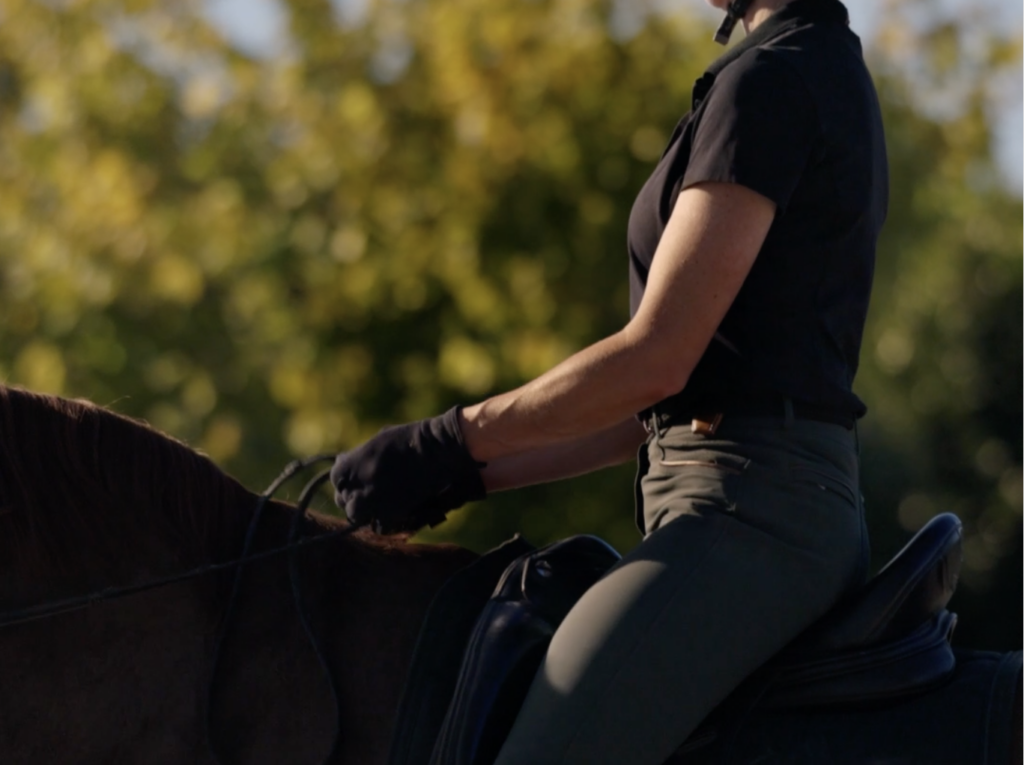
Your Hands Are the End of the Chain
Your hands sit at the end of a very connected system.
Your shoulders influence your arms and hands.
Your shoulders sit on your ribcage.
Your ribcage is organised by your trunk.
Your trunk is supported by your pelvis.
And your pelvis depends on what your hips and legs are doing underneath it.
So when your hands feel unsteady, it is worth looking further down the chain.
The movement you see at the reins may simply be the final expression of something happening elsewhere.
The Body Seeks Stability First
If your body does not feel secure enough through the seat and trunk, it will find stability somewhere.
Sometimes that place is the hands.
They hold.
They brace.
They adjust.
Not because you are deliberately riding with too much hand, but because your body is solving a stability problem in the easiest place available.
Why Your Hands Keep Moving
If the trunk is not quietly supporting you, the upper body has to work harder.
If the ribcage shifts or braces, the shoulders move with it.
And if the shoulders do not have a stable but responsive base, the hands have very little chance of staying quiet.
That is also why one rein can feel completely different from the other.
The hands are not only responding to the horse.
They are responding to everything happening underneath them.
Why “Keep Your Hands Still” Doesn’t Work
You can create stillness by holding. But that is very different from having a body that naturally allows the hands to be quiet.
If the support underneath has not changed, the hands will eventually return to whatever strategy the body needs.
That is why it can feel like something you correct again and again without ever really solving.
What Steady Hands Actually Are
Steady hands are not rigid hands.
They are not hands that have been pinned into position.
They are supported hands.
Hands that can follow movement without losing connection.
Hands that can make tiny adjustments without becoming busy.
Hands that can stay soft because they are not being asked to stabilise the whole rider.
That combination of softness and stability comes from much more than the hands themselves.
Where the Change Really Happens
As the support underneath improves, the hands often change almost as a byproduct.
The trunk becomes better able to manage movement.
The ribcage becomes less reactive.
The shoulders have somewhere more stable to sit.
And suddenly the hands do not have to do quite so much.
They can stop bracing.
They can stop trying to organise the rider.
And they have more freedom to simply follow the horse.
A Different Way to Approach It
Next time your hands feel busy, resist the urge to immediately correct them.
Instead, notice what is happening underneath.
Can you breathe easily through your ribcage?
Do your shoulders feel available, or are they working to hold you up?
Does your pelvis feel secure?
Can your trunk support you without becoming rigid?
Sometimes changing one of those things changes the hands almost instantly.
The Bigger Picture
Steady hands are often an outcome.
They emerge when the rider has enough support to stay organised without becoming rigid.
When the hips can move.
When the pelvis can follow.
When the trunk can support.
When the shoulders can remain available.
Then the hands are no longer being asked to solve problems that belong somewhere else.
And that is when contact often begins to feel quieter, softer and more consistent.
Where to Begin
If your hands feel unsteady, busy or different from one side to the other, I would not start by trying harder to control them.
I would start by improving the body underneath them.
For many riders, that means developing better trunk support, shoulder organisation and pelvic control—while also making sure the hips have enough freedom to move with the horse.
That is exactly how we approach rider training inside DRT.
The Core Stability Program helps build the deep support and control that allows the upper body to stay organised.
The Strength Roadmap builds the strength to maintain that support as the demands of riding increase.
And if restriction through the hips is part of the picture, Hip Suppleness is a great place to begin creating more freedom.
Because steady hands are rarely something you manufacture at the reins.
They are often what appears when the rest of the body no longer needs the hands to help hold everything together.
And that is a very different kind of stillness.